Showing posts with label David Fincher. Show all posts

Tuesday, December 8, 2020

Mank (2020) review


While it has admittedly been more than half a decade since his last film, Gone Girl, came out in 2014, the arrival of a new David Fincher feature is always guaranteed to be a big deal for the film fan community. After all, that’s simply what’s to be expected when you’re talking about a filmmaker who’s been responsible for some of the most critically acclaimed films of the past few decades such as Fight Club, Se7en, and The Social Network. But as for his newest feature, Mank, Fincher has a considerably personal connection to this screenplay since it was written by none other than his father, Jack Fincher. A biopic that explores screenwriter Herman J. Mankiewicz’s experiences while developing the screenplay for Orson Welles’ 1941 feature Citizen Kane (AKA the film that is widely regarded as the ‘greatest film ever made’), David Fincher had originally planned on making it after finishing his work on 1997’s The Game. Unfortunately, those initial plans (which would’ve starred Kevin Spacey (pre-scandal, of course…) as Mankiewicz and Jodie Foster as Hollywood starlet Marion Davies) weren’t able to come to fruition due to Polygram, the studio that Fincher worked with on The Game, being uneasy about his intent to shoot the film in black-and-white. And if that weren’t enough, Jack Fincher sadly wouldn’t live to see his script get made as he died on April 10th, 2003 after a yearlong bout with cancer. But now, fresh off his work on the second season of the crime thriller series Mindhunter, David Fincher has finally brought his father’s magnum opus to life as the latest Netflix original release. Simply put, it’s a film that will certainly attract some major attention during awards season; granted, I don’t think that it’s Fincher’s ‘best’ film, but at the same time, it gives you everything that you’ve come to expect from one of the industry’s most revered filmmakers.

The year is 1940 and prestigious screenwriter Herman J. Mankiewicz (Gary Oldman) has just begun working on his next project. Despite recently suffering a leg injury in a car crash that leaves him almost entirely bedridden, he is approached by Orson Welles (Tom Burke) to write the screenplay for his first feature film with RKO Pictures, who have given him full creative control over the project. Due to his injury, Mankiewicz is brought to a secluded ranch in Victorville, California where he can both rest up and write the screenplay at a location that thoroughly bans alcohol, which is an important thing for Mankiewicz since he regularly suffers from an addiction to it. Despite this, however, Mankiewicz soon finds himself slipping back into his old habits, which is a problem that both Welles’ producer John Houseman (Sam Troughton) and Mankiewicz’s secretary Rita Alexander (Lily Collins) must deal with. And to make matters worse, Mankiewicz then becomes embroiled in some major scandals over the content in the screenplay (namely, the potentially hostile reactions from those who the characters are ostensibly modeled after), which gets to the point where he and Welles get into some heated arguments over who should receive the screenwriting credit. While all this is going on, the film also delves into some key moments from Mankiewicz’s past such as the conflict of integrity that emerged between him and his superiors at MGM, founder Louis B. Mayer (Arliss Howard) and executive Irving Thalberg (Ferdinand Kingsley) over their substantial involvement in the 1934 election for the Governor of California. And then, of course, there’s also the matter of his tense relationship with the country’s most prominent media tycoon, William Randolph Hearst (Charles Dance), for whom the main character of Citizen Kane, Charles Foster Kane, is clearly based on.

As I noted back in the intro, Fincher’s insistence on shooting this film in black-and-white to honor Citizen Kane’s cinematography was the main reason why he was never able to get it made when he originally wanted to. Now that the film has finally come out, it’s safe to say that this goal of his was completely worth it in the end because this film’s cinematography (done by Erik Messerschmidt, who worked with Fincher on Mindhunter) is fantastic. The film’s amazing technical merits don’t stop there, however, as Fincher and his team go above and beyond to make it look and feel like a classic 40’s picture. Whether it’s the frequent appearances of film projection cue marks (or, as another Fincher film called them, ‘cigarette burns’) or Fincher’s go-to composers, Trent Reznor and Atticus Ross, creating a more classical score rather than their usual electronic pieces, Mank is a figurative and literal ‘period piece’. And overall, a lot of this does make up for some of the film’s narrative shortcomings; namely, the fact that its proceedings can often feel a bit dry. It is worth noting that the film’s plot is largely inspired by one of the most controversial pieces in the history of film criticism, Raising Kane, a 1971 essay written by Pauline Kael that argued that Herman J. Mankiewicz was solely responsible for Citizen Kane’s script. However, Kael’s arguments have since been discredited by several sources, and to this film’s credit, Fincher and producer Eric Roth did make some changes to his dad’s script so that it doesn’t completely vilify Orson Welles. Still, because the film focuses so much on Mankiewicz’s efforts to write the script, it feels like we’re not getting the whole story behind everything that went into the film’s inception, like how the lives of folks like William Randolph Hearst and Marion Davies were impacted by them being the inspiration for the film’s characters.

Granted, it goes without saying that this is not a film about the making of Citizen Kane. Instead, it’s about the man who went through hell and high water to bring Orson Welles’ masterpiece to life, and with that in mind, the film does get its points across on everything that ultimately made Herman J. Mankiewicz a tragic figure. But because of the lack of some key bits of context regarding Citizen Kane’s impact, some of the film’s messages end up feeling rather muddled since they aren’t quite fully articulated. That said, though, I will give the film credit in that one of its key subplots in which Mankiewicz uncovers a conspiracy where his superiors are filming bits of propaganda to hinder their political opponent… is scarily relevant. And, of course, Mank’s biggest selling point is that it’s very much an ‘actor’s showcase’ feature headlined by Gary Oldman who, as to be expected, is outstanding in the title role as he brilliantly encapsulates Mankiewicz’s persona as someone who can be both the smartest person in the room and one whose life and reputation ends up being tragically undone by his raging alcoholism. He’s then backed by a pair of excellent performances from Amanda Seyfried and Lily Collins as the film’s female leads, Marion Davies and Rita Alexander. While the film largely focuses on Mankiewicz, both Seyfried and Collins manage to hold their own against Oldman, namely by being some of the only people who can reasonably put up with Mankiewicz’s drunken antics. After that, there are plenty of strong performances from the rest of the film’s supporting cast, including Arliss Howard as the conniving Louis B. Mayer and Tom Pelphrey as Mankiewicz’s more level-headed brother Joseph. Finally, while he’s not in the film that much (which ties into the issue of the film not properly elaborating on Hearst’s influence on Citizen Kane), Charles Dance makes the most of his limited screen-time as the emotionally composed but utterly imposing media tycoon.

Now despite some of the things that I’ve said in this review, I want to make it clear that I don’t ‘dislike’ this film. David Fincher’s Mank is a well-directed and terrifically acted biopic that thoroughly succeeds in being an earnest but not overly sentimental tribute to classic Hollywood. On the surface, it’s easy to see what this film is primarily trying to do; namely, honoring the legacy of Herman J. Mankiewicz, a man who, despite his many flaws, was clearly ahead of his time as a writer. However, as noble as its intentions are, the film doesn’t exactly do the story behind the conception of the ‘greatest film of all-time’ justice. Overall, it feels like an incomplete retelling of this important moment in cinematic history since it’s almost entirely focused on Mankiewicz’s side of the story. And while it does boast some good messages such as the importance of integrity and giving credit where credit’s due, the lack of proper subtext results in the impact of these themes not being as effective as the film wants them to be to the point where the whole film ends up being emotionally empty. It’s not a dull watch, by any means, but despite how fully admirable it is that David Fincher wanted to stay as true to his dad’s original script as he possibly could, it really could’ve benefitted from some additional rewrites (and not just the edits made by Fincher and Eric Roth that I mentioned earlier). Still, while its dry proceedings may prove to be a bit much for casual viewers, Mank is a wholly impressive technical achievement that feels like it was lifted directly from the cinematic era in which it takes place. For fans of David Fincher, this is obviously an absolute must-watch as it dutifully upholds his distinguished track record as a director despite its flaws. At the same time, though, those flaws are the main reason why I wouldn’t necessarily call this one of the best films of the year.

Rating: 4/5

Tuesday, May 16, 2017

Alien Series Retrospective (1979-2012)

Image result for alien series logo

In 1979, a sci-fi horror film was released to theaters, with one of the most iconic taglines in film history; ‘In Space, no one can hear you scream’. This tagline was for director Ridley Scott’s classic, Alien, a film that has gone on to become one of the most iconic films of the sci-fi genre while also spawning a highly successful media franchise in the years since. And this weekend, Scott returns to the franchise that he helped create with Alien: Covenant, a follow-up to the franchise’s 2012 ‘prequel’ Prometheus, which he also directed. By the looks of it, this new film is returning to the series’ original roots as an intense sci-fi horror flick. And in honor of its release, today we’ll be looking at the films in the Alien franchise when it was at its highest of highs… and its lowest of lows. Specifically, we’ll be looking at its four initial installments, which starred Sigourney Weaver in the role of Lt. Ellen Ripley, and Prometheus. I won’t be covering the two Alien vs. Predator crossover films that came out in 2004 and 2007, respectively, for multiple reasons. First off, if I did decide to cover these films, I’d have to look at the Predator films as well, and I’m saving that for the upcoming Predator film, directed by Shane Black, which isn’t set to come out until next summer. Also, I’m aware that both AvP films have attracted a generally negative reaction from both critics and audiences. So… I didn’t want to bother with them anyway. Though with that said, I guess that I will have to cover those eventually when I do that Predator post next year. Well, until then, grab your big guns and avoid those alien eggs because here is my look back at the films of the Alien franchise.

ALIEN (1979)

Image result for alien 1979 poster

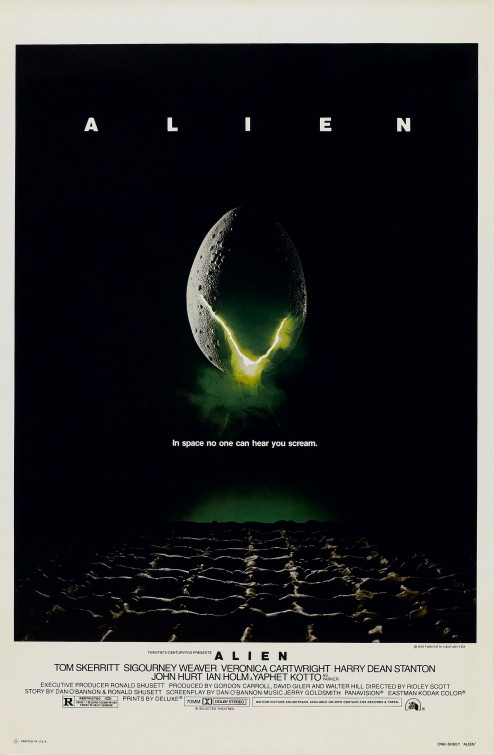
We start things off, of course, with the original Alien from 1979; Ridley Scott’s classic tale of a spaceship crew who are awoken from stasis to investigate a mysterious transmission from an uncharted planet. This investigation, however, soon results in the crew being hunted by a terrifying alien creature that’s literally ‘birthed’ from one of their own crewmates. While initially polarizing amongst critics upon release, it has since gone on to become one of the most iconic films of the sci-fi genre, and rightfully so as it’s an excellently-made space-set chiller. A lot of this is due to Scott’s direction. His use of long, slow-moving, and uninterrupted takes helps add to the overall suspense, along with the general nature of the film’s setting. The film is primarily set within the dark and cramped confines of the crew’s ship, the Nostromo, and it results in an effectively intense and unsettling atmosphere because of the claustrophobic feeling throughout. Even moments that don’t involve the Alien, like when crew member Ash (Ian Holm) is revealed to be an android, have a great and suspenseful vibe to them. In fact, the Alien doesn’t even appear until just under an hour in. Like I said before, this is a slow-moving film but there’s never a dull moment in this. Thus, it’s easy to see why Alien is still regarded as one of the best films in both the science-fiction and horror genres. While I’m not that big a fan of the latter genre, this film does succeed in being a part of it thanks to Ridley Scott’s excellent direction and a solid cast that includes the likes of Sigourney Weaver, Tom Skerritt, Ian Holm, and John Hurt. Heck, this wouldn’t be the last time that a sci-fi film directed by Scott would overcome initial critical reception to become a seminal classic of the genre… but more on that when Blade Runner 2049 comes out.

Rating: 5/5!

ALIENS (1986)

Image result for aliens 1986 poster

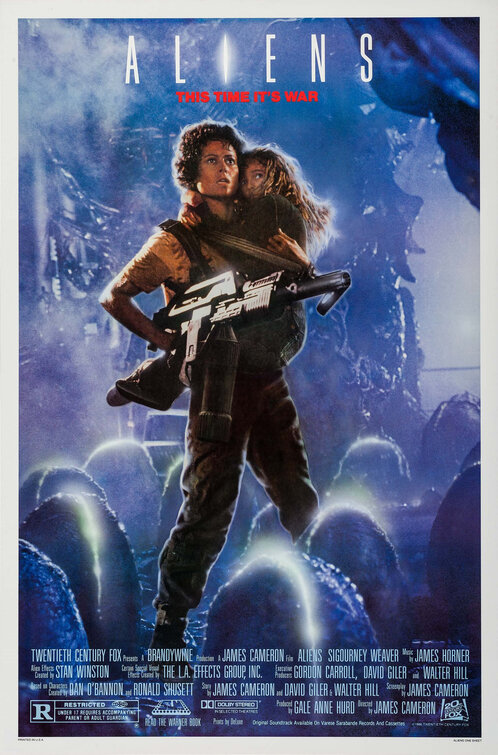
After making a name for himself in 1984 with The Terminator, James Cameron was brought on to write and direct the follow-up to Alien, titled Aliens. However, Cameron faced some scrutiny during production from the primarily British crew, who felt that he was inexperienced for a project of this magnitude. However, upon release, Aliens would go on to become just as beloved as the original Alien. This, of course, leads to the primary debate of the franchise; Alien or Aliens? Me personally, I lean slightly more towards the latter. I’ll admit that this may be because I’m not a big horror fan but this shouldn’t take anything away from Ridley Scott’s masterpiece. As for Aliens, though, while Cameron does lean more towards the action genre in this sci-fi story, it doesn’t mean that he completely shies away from the franchise’s horror roots. There are still some incredibly tense and creepy moments throughout this film along with the same great dark and claustrophobic set designs that the first film had. Ultimately, though, this film is more action-oriented than the first and it delivers on that aspect brilliantly. Plus, this film has arguably the best ensemble cast in the history of the franchise. Of course, it’s all led by Sigourney Weaver as Ripley, who went from being the secondary protagonist of the original film to one of cinema’s most badass action heroines in this film. Heck, she was so good in this film that she got nominated for an Oscar for Best Actress, a rarity for the genre. But the rest of the cast is excellent as well, including Carrie Henn as the scared young girl Newt, who Ripley becomes a surrogate mother to, and Lance Henriksen as this film’s android, Bishop. Even minor characters like Hudson (the late Bill Paxton (RIP); “Game over, man, game over!”) and Vazquez (Jenette Goldstein) are extremely memorable. In short, Aliens is just as much of a masterpiece as its immediate predecessor, but if you forced me to choose one over the other, I’d go with Cameron’s sci-fi action epic.

Rating: 5/5!

ALIEN 3 (1992)

Image result for alien 3 poster

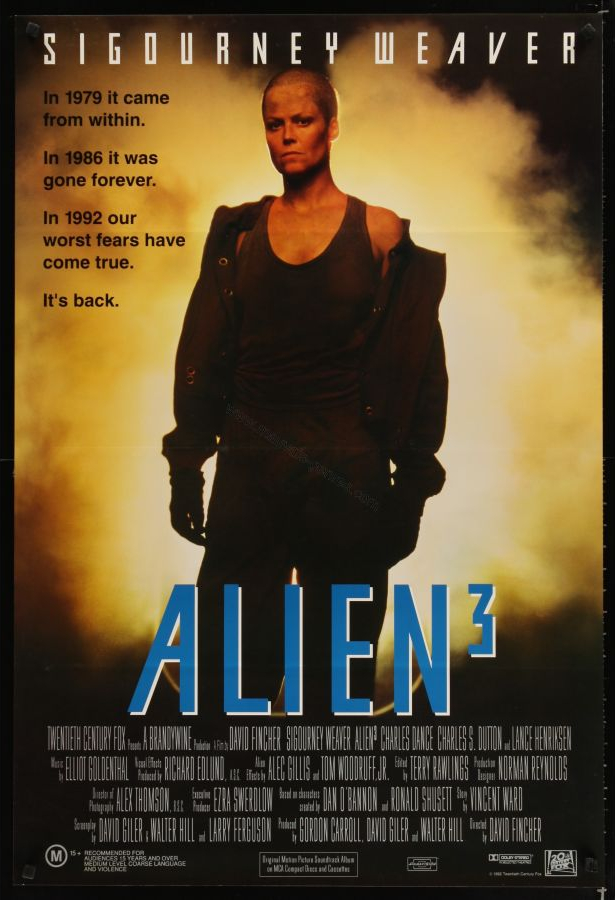
I’ve talked about this film before in my Directorial Retrospective on its director, David Fincher, way back in 2014 so I won’t repeat myself too much here. Bottom line; Alien 3 was, unfortunately, a disappointing follow-up to the first two Alien films, namely because it went through one of the most tumultuous productions of all time. Several writers and directors were brought in to try and figure out its overall plot, from William Gibson’s HIV-influenced storyline to Vincent Ward’s concept of a ‘wooden’ planet that held a monastery. Ultimately, David Fincher was brought in to direct; sadly, his directorial debut put him through hell. He was given little time to prepare and didn’t have a full script when filming began. To make matters worse, the studio blocked many of his ideas during the shoot; thus, it’s easy to see why Fincher has since disowned the film. I don’t blame him; the primary flaws of the film aren’t his fault. Alien 3 makes the questionable decision of going down a dark and gloomy route that goes against the optimistic ending of the previous film. Case in point, the opening scene sees most of the surviving cast of the previous film killed off, with Ripley being forced into an all-male prison. Of course, Fincher is well-known nowadays for his dreary thrillers but here, it just doesn’t translate as well. The supporting characters are all bland, partially because they’re predominantly a collection of similar-looking bald white men. Not to mention, these are all murderers, rapists, etc.; they’re not exactly a sympathetic bunch. Thankfully, Sigourney Weaver is still great as always as Ripley and the film’s ending is a highlight, as Ripley sacrifices herself when she learns that an Alien has manifested within her to keep the Weyland Corporation, the primary ‘evil corporation’ of the franchise, from using it for nefarious purposes. Had it not been for the next installment of the series, this would’ve at least ended the franchise on a decent note despite the film that it came from.

But now, let’s talk about the film’s alternate cut. Each of the first four Alien films has gotten a ‘Special Edition’ released over the years. But while the first two films didn’t add ‘that’ much to their Special Editions (though James Cameron and Sigourney Weaver have expressed preference towards the ‘Special Edition’ of Aliens for having more depth to it), the ‘Assembly Cut’ of Alien 3 adds in 30-plus minutes of material to try and improve upon the original theatrical cut. And for the most part, it does manage to do that. Some additions are welcome aesthetic changes, like having Ripley end up on the prison planet’s beach instead of being found in the crashed ship (which fixes a few plot-holes from the theatrical cut) and having the Alien emerge from an ox instead of a dog. But then there are some additions that improve the narrative, like a greater focus on the inmates’ religious beliefs and how Ripley’s arrival puts that into chaos, allowing for some additional character development for some of the main inmates. Crazed inmate Golic (Paul McGann), particularly, is focused on more in this version of the film as we see him become fascinated with the alien, so much so that he begins to compromise the protagonists’ efforts to destroy it. However, despite the improvements that it makes over the clearly truncated Theatrical Cut, I still can’t go as far as to say that it completely saves the film. Parts of it are still a chore to sit through, especially considering that the extended cut is almost two-and-a-half hours long. In conclusion, if you’re going to watch Alien 3, stick to the ‘Assembly Cut’ as it’s more in line with what Fincher was going for. Still, it isn’t enough to save the film, which will easily go down as one of the most hellish productions in film history, from being a mediocre conclusion to the Alien trilogy, a designation which lasted five years until…

Ratings: Theatrical Cut: 1.5/5 Assembly Cut: 2.5/5

ALIEN: RESURRECTION (1997)

Related image

While Alien 3 ended with the death of Ellen Ripley, the studio ended up reviving the franchise half a decade later with Alien: Resurrection. To bring back Sigourney Weaver, the plot involves scientists cloning Ripley, who gains ‘alien’ abilities due to her DNA being mixed with the Alien queen that was first introduced in Aliens. Like its predecessor, this film was primarily developed by a soon-to-be-famous filmmaker; in this case, the film’s writer, Joss Whedon, before he became known for his hit TV shows like Buffy the Vampire Slayer and way before The Avengers. And like with Fincher and Alien 3, the flaws of Resurrection are not primarily his fault. What we have here is a film that suffers from major tonal inconsistency. Whedon intended for the film to have a tongue-in-cheek feel to it; however, the film’s director, Jean-Pierre Jeunet (Amelie), decided to play everything straight-faced. Thus, the film maintains a ‘serious’ tone throughout despite various moments that are extremely over-the-top, especially those that involve Brad Dourif as one of the scientists in charge of the whole process. This over-the-top nature also extends to the cast. Sigourney Weaver is still just as great as she’s always been as Ripley but the rest of the cast is hit-and-miss because many are just hamming it up. And while the supporting characters are more memorable than the ones from Alien 3, they’re still a generally expendable group. Overall, Alien: Resurrection is more ‘enjoyable’ than Alien 3, partially because it doesn’t carry the same grim tone. However, the film’s tone is all over the place, resulting in unintentionally hilarious moments that were trying to be serious. Thus, what was intended to be a better conclusion to the series than its predecessor just made the whole situation worse.

Rating: 2/5

PROMETHEUS (2012)

Image result for prometheus poster

And finally, we conclude with the film that has become one of the most polarizing films in recent years; the pseudo-prequel to the Alien franchise, Prometheus. Ridley Scott returned to direct this film which, for the record, is not technically a prequel to the original Alien. It takes place in the same general universe as the other films but it is, ultimately, its own thing (e.g. this film does not take place on the same planet visited in the original Alien, despite the clear similarities). And to the film’s credit, it does a solid job of being its own separate story in this larger universe. Its overall plot, which delves into the mystery of humanity’s origins, is a fascinating one and I wouldn’t say that there’s a dull moment in the entire film. The production design is fantastic, particularly due to Scott emphasizing the use of as many practical effects as possible. And the film’s ensemble cast is solid as well, particularly Noomi Rapace as main protagonist Dr. Elizabeth Shaw, a much different kind of character compared to Ripley, Michael Fassbender as the enigmatic android David, and Idris Elba as the ship’s charismatic captain, Janek. But while the film is well-made on a technical level, its writing has been the main source of its polarizing response. Many have criticized the film for bringing up tons of questions that went unanswered. My thoughts on the matter? Well, I do agree that there are some plotlines that were only given vague explanations, like why the crew comes across a gigantic statue of a head during their mission. I think it’s safe to say that the ambition of the filmmakers might’ve surpassed what they could do in just one film. However, from the looks of it, Alien: Covenant will at least answer some of the unexplained mysteries that this film explored. And overall, I wasn’t too bothered by some of the more mysterious elements of the plot; I’d argue it makes the whole film more interesting. Thus, you can say that, overall, I’m still in the camp that likes this film. Admittedly, it may partially have to do with the fact that I have a personal connection to this film because it’s the first R-rated film I ever saw in theaters, but I do think that it’s still worth checking out if admittedly more for its technical aspects than the writing.

Rating: Way back in 2012, my first year on this blog, I had reviewed this film and gave it a 4.5/5 rating. Upon re-watch, I decided to lower that initial rating down to a 4/5 rating, which is still a strong rating on my scale.


"Final report of the commercial starship Nostromo, third officer reporting. The other members of the crew — Kane, Lambert, Parker, Brett, Ash and Captain Dallas — are dead. Cargo and ship destroyed. I should reach the frontier in about six weeks. With a little luck, the network will pick me up. This is Ripley, last survivor of the Nostromo, signing off."

Thursday, October 9, 2014

Gone Girl (2014) review


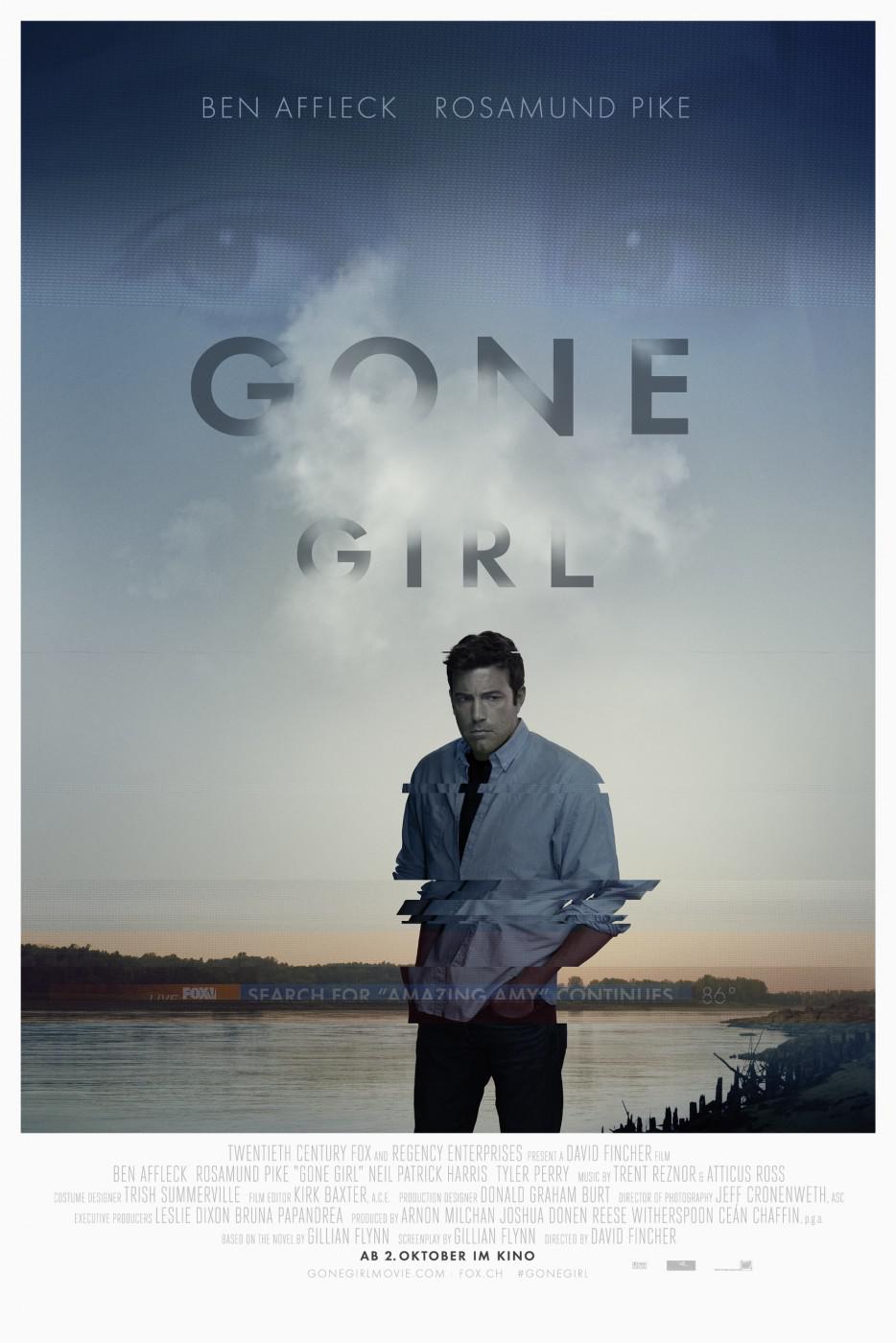
David Fincher is one of the absolute best directors currently working today in Hollywood. Sure, his career may not have gotten off to a good start when he was hired to direct ‘Alien 3’ but that movie isn’t his fault. He was stuck in a terrible situation working on a movie with an infamously hellish production where the studio vetoed every major decision he had. It was such a disaster for Fincher that it’s completely understandable why he doesn’t view that film as ‘his film’. Fortunately that wasn’t the end of his career as since then, he has yet to make a bad film; ‘Se7en’, ‘Fight Club’, ‘The Social Network’, the list goes on and on. For his newest film, Fincher takes on his second straight book-to-film adaptation in a row (after 2011’s ‘The Girl with the Dragon Tattoo’) with ‘Gone Girl’, based off of the best-selling novel of the same name by Gillian Flynn, who also wrote the film’s screenplay. With ‘Gone Girl’, Fincher delivers what may just be his darkest film to date. After all, if there’s one thing he is known for, it’s for making incredibly dark and pessimistic films and this film is no exception. But it’s also an incredibly compelling and sometimes darkly comic mystery thriller that features a terrific cast headlined by its two leads. This makes ‘Gone Girl’ yet another great entry in Fincher’s prestigious post ‘Alien 3’ filmography… even though it is quite messed-up at times.

Nick Dunne (Ben Affleck) and Amy Elliott (Rosamund Pike) first meet a party and almost immediately develop a romantic connection. They soon marry and two years later, they move from New York to Nick’s hometown in Missouri when his mom is stricken with cancer. On the day of their fifth wedding anniversary, Nick returns home after work to find Amy missing as well as signs of an apparent struggle. The police immediately start investigating into the disappearance and possible kidnapping as the case makes headlines nationwide due to the fact that Amy is the inspiration for the best-selling book series ‘Amazing Amy’ written by her parents. However, as the days go on with no sign of Amy, things suddenly take a dark turn for Nick when certain evidence starts to paint him as a possible suspect, revealing that his marriage wasn’t as happy as it looked. As he slowly becomes ‘the most hated man in America’, Nick must find a way to prove to everyone that he didn’t kill his wife. And really, that’s as far as I can go in terms of the film’s plot because otherwise I would be giving away key plot-points. 

Pretty much as soon as the film started, I was immediately hooked by the film. That’s usually the case with Fincher’s films; even when they are nearly three hours long, they always hold your interest from beginning to end. This one in particular really shines because… well, of how messed up it is. With that said, I want to note that I went into this film having not read the book so I didn’t have any idea of how this story was going to play out and as a result, the film was much darker than I expected. Then again, this is a David Fincher movie so that’s not too surprising. But at the same time, as it is also expected from a Fincher film, the story is incredibly compelling and the film is incredibly well-shot. It’s also darkly comic at times and is a biting satire of various aspects of our lives, like how the media interprets certain events without knowing everything about what’s really going on (as shown via the character of Ellen Abbott (Missi Pyle), a TV host who paints Nick out to be a ‘sociopath’ given his behavior regarding the whole case) and how we as an audience are influenced by this or how the economy can have an effect on a marriage, as at one point Nick and Amy argue over Nick’s spending habits after they both lose their jobs. This all makes ‘Gone Girl’ one of the best written screenplays of this year so far. As for how faithful this film is to the book, from the perspective of someone who hasn’t read the book, it seems pretty faithful right down to the fact that it retains the controversial ending of the book that was allegedly changed by Flynn herself so that it wouldn’t be spoiled.

The film’s cast is pitch-perfect, particularly in regards to its two leads. As Nick, Ben Affleck is perfectly cast in the role of a man who becomes highly scrutinized by the media, which of course is something that Affleck experienced quite a lot in not only the years before his big comeback in 2007 but even recently after he was cast in ‘Batman v. Superman’. Here he gives the best performance of his career. But ultimately this movie belongs to Rosamund Pike as Amy. Like I said before, I hadn’t read the book going in and I didn’t realize how complicated of a character Amy really was. Going in, I thought she was just going to be the innocent victim but, without really giving anyway here, it turns out that she’s not as innocent as we thought. Amy’s transformation over the course of the story is fascinating and Pike absolutely owns the role. I’ll be genuinely shocked if she’s not nominated for Best Actress at this year’s Oscars because this is one of the best performances that I’ve seen this year. Affleck and Pike lead a talented cast which also includes Neil Patrick Harris in a very much against type role as one of Amy’s ex-boyfriends, Tyler Perry as Nick’s attorney, Carrie Coon as Nick’s twin sister, and Kim Dickens and Patrick Fugit as the two lead cops in the case of Amy’s disappearance.

‘Gone Girl’ is, in many ways, a very messed-up movie and yet it manages to be an incredibly compelling mystery story which of course, as a director, is where Fincher is truly at his best as proven through films like ‘Se7en’ and ‘Zodiac’. But in all seriousness, I legitimately did not expect some of the dark turns that the story took, particularly in regards to Amy and the journey her character takes in this film. The marketing thankfully hasn’t given any of this away so those who go in who haven’t read the book will certainly be surprised by the dark turns that this story takes. As for those who have read, it seems like it stays true to the book, even featuring the same ending and while I may be in the minority on this, I kind of admire the ending for being just as messed up as the story; in other words, I think it actually fits rather perfectly with the tone of the film. In short, ‘Gone Girl’ features great direction from David Fincher, a terrific cast headlined by Ben Affleck and Rosamund Pike giving the best performances of their careers, and a smartly-written dark and satirical screenplay by author Gillian Flynn. Is this Fincher’s best film? That may be up for debate at the moment but one thing is for certain; Fincher’s hot streak following his initial mishap of ‘Alien 3’ continues with yet another outstanding film.


Rating: 5/5!

Thursday, October 2, 2014

Director Retrospective: David Fincher


With the impending release of ‘Gone Girl’ this weekend, it’s time for another directorial retrospective. Today, we’ll be looking at the filmography of ‘Gone Girl’s director, David Fincher. Before he became a director, Fincher actually got his start in Hollywood working for ILM on films like ‘Return of the Jedi’ and ‘Indiana Jones and the Temple of Doom’. He then started directing music videos for artists like Madonna, Michael Jackson, and Paula Abdul. Then, in 1992, he made his directorial debut though unfortunately it didn’t turn out so good. But as we’ll soon see, that wasn’t really his fault and thankfully, his career managed to rebound after that. Overall, Fincher has one of the best track records of any director currently working in Hollywood. Excluding his first film, he has not made a bad film and given the current critical reception for ‘Gone Girl’, it looks like Fincher has yet another success on his hands. But for now, it’s time to look back on his filmography. I’ve already briefly discussed two of these films, ‘Social Network’ and ‘Girl with the Dragon Tattoo’, in my lists for my top 10 favorite films of 2010 and 2011, respectively, so I’ll just be expanding on what I said in those two posts here. So now without further ado, here are the films of director David Fincher.

ALIEN 3 (1992)
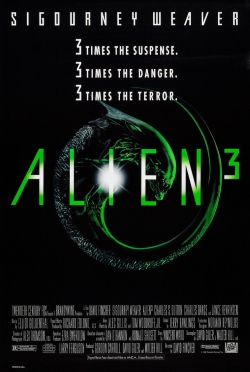

Fincher’s directing career unfortunately got off to a fairly rocky start when he was hired to direct ‘Alien 3’, the third film in the highly successful ‘Alien’ franchise. It all started in 1979 with Ridley Scott’s ‘Alien’, a film that stands as not only a phenomenal sci-fi film but also a very effective horror film. It utilized the cramped nature of its locales to great effect, establishing a sense of claustrophobia and anxiety. That film was followed in 1986 with ‘Aliens’, directed by James Cameron, fresh off of 1984’s ‘The Terminator’. ‘Aliens’ took a different approach than ‘Alien’, opting instead for a more action-based aesthetic and it too is one of the best of its genre. Sigourney Weaver established herself as one of the great female action heroes but the film also had a great cast of memorable characters, something that isn’t always easy to do when it comes to these kinds of movies. So as you can see, Fincher had two incredibly tough acts to follow and ultimately ‘Alien 3’ ended up being a fairly mediocre threequel. But in the end, it isn’t Fincher’s fault the film didn’t turn out that good. This is a case of a film that had an infamously hellish production and that certainly shows when watching the final product.

During pre-production, the film saw numerous rewrites occur, each of which saw major changes to the film’s plot. One draft apparently had the action set on Earth. While this ultimately wasn’t what the film was about, an early teaser of the film had the tagline ‘On Earth, Everyone can hear you Scream’, making it one of the misleading teasers ever. Another draft was to have the film be set on a ‘Wooden Monastery’ full of monks. There were also numerous directors considered for the film, including David Twohy, Renny Harlin, and Vincent Ward (who came up with the ‘Wooden Monastery’ concept). When Fincher was brought on, the experience wasn’t very pleasant for him. He had little time to prepare for the film before it was to start shooting, and once shooting did begin, the script wasn’t even complete yet. It had to be worked on as shooting was going on. But even worse is that pretty much every major idea that Fincher had about the film was shot down by the execs at Fox. With all of this in mind, it’s very much clear why Fincher now disowns the film… seriously, can you blame him? I’d disown the film too if I was in his situation. But anyway, time to get to the actual film itself.

First off, the movie pulls the incredibly stupid move of killing off all of the remaining characters from ‘Aliens’ except for Ripley. As I stated earlier, ‘Aliens’ had a great cast of characters and to see most of them killed off is, to quote James Cameron, ‘a Temple of Doom slap in the face’ to the fans. To make matters worse, Ripley ends up on an all-male prison planet; to put it simply, there is no ‘silver lining’ for Ripley here. This film has an incredibly bleak tone to it and while that is something that Fincher is really good at doing as proven by his later films, here it is a little bit too much. You’d think that after all that she had gone through in both ‘Alien’ and ‘Aliens’, you would think that Ripley would catch a break but that’s not the case here. Also, on another note, due to the fact that this is an all-male prison planet where all of the men have shaved heads, it is incredibly hard to tell them apart from one another because they all look the frigging same so you don’t really care about any of them because you’ll be spending more time trying to remember who’s who.

Despite all of this, there are two legitimately great things about this movie. The first is Sigourney Weaver, who is once again fantastic as Ellen Ripley. She carries the movie on her back though the rest of the cast is pretty good as well. It’s just that, as I noted earlier, the majority of them look exactly the same so this is more in regards to their performances than the characters themselves. The other great part of this film is the ending (so… Spoilers!). After defeating the Alien of the film, Ripley learns that she has the embryo of an Alien queen inside of her. When the Weyland Corporation offers to remove it from her body, Ripley sacrifices herself knowing that they are going to use it for biological weaponry. It’s an incredibly bold move on behalf of the filmmakers to kill off the main character of the franchise and it looked as if this was going to be the final film in the series, though that ultimately wasn’t the case with the release of ‘Alien: Resurrection’ five years later (which for the record I haven’t seen yet). And unfortunately, despite those two great aspects of ‘Alien 3’, they don’t help it that much as it is still a very inferior follow-up to the first two ‘Alien’ films that came before it. But of course this isn’t the fault of Fincher given the situation that he was in while it was being made. I’m aware of the film’s ‘Assembly Cut’, which is viewed as the superior cut of the film, which is also notably very different from the original theatrical cut, but I haven’t seen it and even with that in mind, I’m not sure how it much it improves the theatrical cut.

Rating: 2/5

SE7EN (1995)
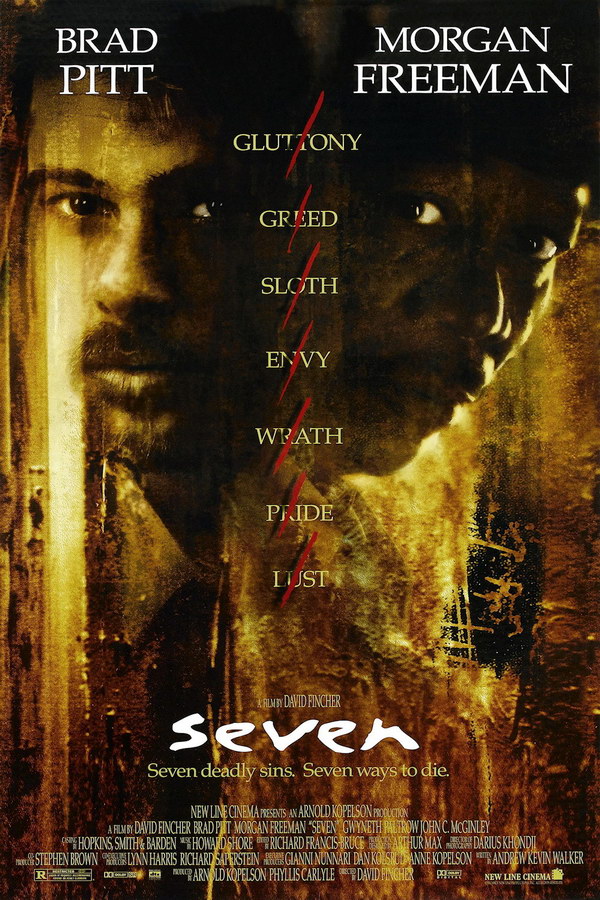

Thankfully, ‘Alien 3’ didn’t sink Fincher’s career as a director as he immediately rebounded with ‘Se7en’, a film in which two detectives (played by Brad Pitt and Morgan Freeman) investigate a series of bizarre murders that are inspired by the seven deadly sins: Greed, Lust, Gluttony, Pride, Envy, Sloth, and Wrath. This film is a much better example of how Fincher does a great job at establishing dark environments, with the film being set in a city that is slowly falling apart where it’s always raining. This fits well with the murders that occur in this film. The majority of them aren’t actually seen happening on screen, but the descriptions of them (e.g. an obese man eating until his stomach burst or a woman whose face was heavily disfigured, resulting in her choosing to end her life instead of having to live with the scars for the rest of her life) certainly hit you hard in how graphic/disgusting they are. But the best part of the film is its two leads, Pitt and Freeman. There is an excellent dynamic between them with Pitt’s character being the hot-headed rookie while Freeman’s character is the calm and collected veteran who is nearing retirement.

And of course, there is the film’s infamous twist ending, which I won’t dare spoil here for those of you who haven’t seen it. Needless to say, it is a fantastic ending. The best way I can describe it without actually talking about what happens in it is that it takes a much darker turn that one might expect but at the same time it fits perfectly given the atmosphere and tone that the film establishes. It’s a good thing that New Line Cinema didn’t reject this ending which they were originally going to do, which would’ve resulted in a much more straight-forward ‘mystery thriller’ ending. But thankfully Pitt declared that he wouldn’t do the film if this ending wasn’t kept in the movie. In the end, it was and ultimately this is why ‘Se7en’ is such a great crime thriller. Fincher’s style matches perfectly with the story and the film holds your interest from beginning to end with a compelling mystery and a truly jaw-dropping finale (‘What’s in the Box??’). Of course, it’s also thanks to a terrific cast headlined by Brad Pitt and Morgan Freeman. In short, ‘Se7en’ is easily one of Fincher’s best films, if not his absolute best.

Rating: 5/5!

THE GAME (1997)


Sandwiched in between the two films that are arguably still David Fincher’s most notable films to date is 1997’s ‘The Game’. In the film, Michael Douglas stars as Nicholas Van Orton, a successful but cold banker who, on his 48th birthday, receives a present from his brother Conrad (Sean Penn). This present is a ‘voucher’ for a ‘game’ run by a new company called Consumer Recreation Services (CRS). He ends up using the voucher and soon finds that this ‘game’ begins to take over his life. As one would expect from a Fincher film, ‘The Game’ is an incredibly suspenseful thriller that has you on the edge of your seat as we see how this game takes over Nicholas’ life. Michael Douglas is fantastic in the lead role as is Sean Penn in his fairly brief appearance in the film (probably about only 10 minutes of screen-time). But unfortunately there is one major thing holding this film back from being one of Fincher’s best films and that is the one thing that has been pretty much universally criticized by almost everyone who seen it; the ending. Even Fincher admits that it wasn’t that good. For those who haven’t seen the film yet, I won’t spoil anything major but I will try and describe to the best of my ability why the ending is so mediocre.

As the movie goes on, Nicholas begins to get very paranoid due to how much ‘the Game’ has affected his life. He loses his house, his money, etc. He begins to suspect that there’s this major ‘conspiracy’ behind the whole thing and confronts the workers of CRS for answers. But he finds out too late that there wasn’t any ‘conspiracy’ going on and does something terrible. Immediately feeling regret for it, he does something out of despair. This climax definitely feels like the ending to a David Fincher film… and then all of a sudden that’s not how it all ends. Instead, it ends more on a ‘happy ending’ where everything is fine. I’m sorry, but this doesn’t really gel well with the shocking conclusion we had just witnessed which, as I just noted, is very much in line with how most of Fincher’s films usually end. I feel that the movie should’ve ended ten minutes earlier because as is, to quote my friend Matt, the ‘true’ ending sort of feels like a major ‘copout’. Now with that said, I still think that the movie is still a very solid mystery thriller but while some may feel that it is Fincher’s most underrated film, I feel that it’s actually his weakest film not counting Alien 3. I do think it is underrated but as for his most underrated… that one would come a decade later. But overall ‘The Game’ is still very much worth checking out.

Rating: 4/5

FIGHT CLUB (1999)


As crazy as it may seem, ‘Fight Club’, based off of the novel of the same name by Chuck Palahniuk, wasn’t as well-regarded upon its initial release as it is today. When it was first released in theaters, it was arguably the most controversial film of 1999. There were those who loved it for its thought-provoking script while those who hated it believed that it was overly excessive in regards to its brutal violence. But since then, this negative reception towards the film has died down considerably and ‘Fight Club’ is now considered to not only be a cult classic, but is also regarded as one of the ultimate ‘guy movies’. Even Palahniuk has admitted that he thinks the film is an improvement over the book. Now when it comes to this film, there has been quite a lot of analysis towards it by those who are much better than I am when it comes to this sort of thing. So because of this, I’m not going into too much detail when it comes to ‘analyzing’ this film’s themes and messages. Instead, I’m just going to talk about my overall thoughts on the film.

‘Fight Club’ is a visual assault on all of the senses, what some may call a ‘mindf***’… and it is frigging awesome. It’s a film that, yes, is full of violence, mostly via the titular ‘Fight Club’ but at the same time it’s a very smartly written film. It’s a biting satire on the consumerist culture and the ‘lost generation’. And that’s just the tip of the iceberg when it comes to this film but like I said, that’s about as far as I go with that stuff. The film features terrific performances from Edward Norton, Brad Pitt, and Helena Bonham Carter. Pitt especially steals the show here as one of the best characters ever to be put onto film; the one and only Tyler Durden. Yes, he may be very extreme at times but he’s also incredibly charismatic and very smart. This was the film that really got me into being a fan of Pitt as an actor. I’ll admit that before I saw this I wasn’t really that big a fan of his, which I guess was mostly because I got really sick of the fact that he was always in the headlines due to his relationship with Angelina Jolie. But this film thankfully changed my mind about all of that. After all, most of the time you should just ‘separate the art from the artist’ like I do with other actors like Tom Cruise and Mel Gibson. Really, what else more is there needed to be said about ‘Fight Club’? It may not have made a big splash initially but in the years since it has earned its rightful place as one of the all-time classics.

Rating: 5/5!

PANIC ROOM (2002)
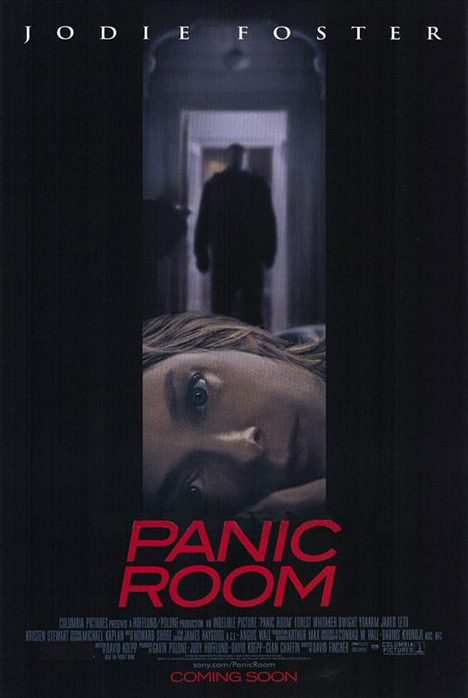

‘Panic Room’ is another one of the forgotten entries in David Fincher’s filmography probably because, on the surface, it’s not as thought-provoking as something like ‘Fight Club’ or ‘Se7en’. Instead, it’s more like your straight-forward thriller film; it’s a ‘popcorn flick’. And according to Fincher, that’s exactly the kind of movie he wanted to make so in short, he definitely delivers on that front. But at the same time, Fincher does, once again, establish an effectively dark atmosphere that fits well with this story of a home invasion. Jodie Foster does a fantastic job in the lead role of Meg Altman, a recently divorced mother who has just moved into a new house with her daughter Sarah (pre-Twilight Kristen Stewart) but who then has to deal with robbers on just the first night they’re there. But really, the major standouts of this film are Jared Leto and Forest Whitaker as two of the three robbers (the other played by Dwight Yoakam). Leto’s an absolute scene-stealer as Junior, the hot-headed member of the group, while Whitaker gives an excellent reserved performance as Burnham, who had a hand in designing the titular ‘Panic Room’ in which Meg and Sarah hide in for most of the film. All in all, ‘Panic Room’ may be the simplest of Fincher’s films in terms of its ideas but it is still a very solid and tense thriller that will have you on the edge of your seat.

Rating: 4/5

ZODIAC (2007)


‘Zodiac’ is quite frankly David Fincher’s most underrated film to date, at least from a commercial standpoint. While the film did get glowing reviews from critics, it wasn’t too successful at the U.S. box office. It only grossed about 33 million stateside, which was only about half of its $65 million budget. Thankfully, it made enough overseas to make its budget back at the box office but still it’s a shame that this film didn’t do so well here. Why is that, you ask? Well, it’s probably because this is a two and a half hour movie that mostly consists of characters talking with one another. There’s not exactly a lot of ‘action’ and pretty much all of that action occurs within the first 45 minutes. But in this case it’s not a problem because the story is just so incredibly compelling. This is based off of the real-life murder case of the ‘Zodiac Killer’, who terrorized northern California in the 60’s and 70’s. The crazy thing about this whole story is that this case has never been solved and while that does technically mean we kind of already know going in how this will all turn out, we’re still engrossed in the movie and we feel the same frustration that those investigating the case are going through. And once you think they’re finally going to solve the case, the film ends with a caption stating that their prime suspect died before he could be questioned and that a DNA test conducted a few years after that was unable to link him to their evidence.

But at its heart, this story is mainly about the obsession of cartoonist Robert Graysmith, who worked for years trying to figure out the identity of the Zodiac killer, even years after the Zodiac killings occurred. It’s interesting how someone like Graysmith, who really shouldn’t even be involved in this case (he is described by many people as a ‘boy scout’) but we do follow him as this investigation consumes every aspect of his life to the point where he loses his job and his wife divorces him. It’s an interesting look into a character’s psyche and Jake Gyllenhaal gives one of the best performances of his career in this movie but he is also backed up by a really solid supporting cast. This includes Robert Downey Jr. as reporter Paul Avery and sure if you really look at it, it’s just Downey Jr. playing Tony Stark (a year before ‘Iron Man’ came out) but you now what? I don’t mind that at all because he’s so damn good when it comes to portraying characters with a ‘cocky/destructive’ personality. And then you factor in the rest of the cast, which includes the likes of Mark Ruffalo, Anthony Edwards, and Brian Cox and you have yourselves one fine ensemble cast. The film is well-shot (and yes, I’m aware that a lot of the scenes were mostly CGI but it’s still some pretty good-looking CGI), well-acted, and has a very engaging story to follow. I highly recommend this one for you all; sure it’s mostly a dialogue movie but it’s still a very intriguing look into one of the most infamous unsolved cases in American history.

Rating: 4.5/5

THE CURIOUS CASE OF BENJAMIN BUTTON (2008)


Some probably like to refer to this movie as David Fincher’s ‘Forrest Gump’ and it’s understandable why. While this film is based (albeit loosely) off of a different source material, in this case a short story by F. Scott Fitzgerald, both films center around the main character living his life over many years. Heck, both films even have the same screenwriter, Eric Roth. However, while I do still really like ‘Forrest Gump’, I think ‘Benjamin Button’ is the better film. While ‘Gump’ is more about nostalgia and American history, this film focuses more on the idea of life and how ultimately nothing lasts forever. The main character of Benjamin Button, who was born with a condition where, at birth, he appears to be an old man and as he gets older, he begins to look much younger, meets a lot of people over the course of his life… and most of them end up dying. Death is a common theme in the film as Benjamin lives his life; he is raised in a nursing home by his surrogate mother Queenie (who later dies), he works on a tugboat that gets caught up in World War II, and he falls in love with a girl named Daisy even though they’re on different life paths. This film really handles this whole situation perfectly and because of that, the film really gets to you on an emotional level.

It’s an incredibly beautiful looking film. The cinematography is absolutely spectacular (what else would you expect from a Fincher film?) and then you also factor in the incredible special effects used in portraying Benjamin as he goes from an ‘older-looking’ child to a ‘younger-looking’ old man. It’s been noted that if this movie had been done at an earlier time than when it finally got made, the role would have required more than one actor in regards to the various periods of life. But thanks to advances in technology, Brad Pitt was able to play the role as much as possible and because of that, he gives one of the absolute best performances of his entire career here. Cate Blanchett and Taraji P. Henson are also fantastic in this film as well and at the film’s core is the love story between Benjamin and Daisy, executed brilliantly here by both Fincher’s directing and the chemistry between Pitt and Blanchett. I’m just going to say it… this is my favorite Fincher film and it’s slowly becoming one of my favorite films of all time. I absolutely love this movie. Not only is it an incredibly beautiful looking film in regards to its visual look but it also does a phenomenal job in its handling of the concept of life and death. I’ll even admit that I get a little teary-eyed at certain points. That’s how great this film is.

Rating: 5/5!

THE SOCIAL NETWORK (2010)


On the surface, a movie about Facebook sort of seems like a really stupid idea… at least that’s what I thought when I first heard about this film getting made. At that time, I remember that I had recently watched this video from collegehumor.com which was a Facebook-themed parody of the film ‘Face/Off’ in which two guys hacked each other’s Facebook account in order to vie for the affections of this one girl they both liked. Back then, I thought that this was the best way anyone could even make a movie about Facebook… and it wasn’t even a real movie. But the great thing about ‘The Social Network’ is that while it is centered on the origins of Facebook, this movie has much more to it than that. It’s also about the legal battles that occurred due to Facebook creator Mark Zuckerberg’s (Jesse Eisenberg) actions during the initial years of the website. In one lawsuit, he’s being sued by the Winklevoss twins (amazingly, both of them are portrayed by the same actor, Armie Hammer), who claim that he ‘stole their idea’ for the website when they had approached him to help them make their own website, ‘Harvard Connection’. And in another lawsuit, he is being sued by his best friend and Facebook co-founder, Eduardo Saverin (Andrew Garfield) after Saverin finds out that he was getting screwed out of his shares of the website.

It’s pretty much a Greek tragedy; Zuckerberg is someone who is undeniably a genius but at the same time, his general lack of social skills and his tendency to judge people end up costing him the value of companion-ship. It’s even sadder when looking at the relationship between him and Saverin; they were best friends and yet Zuckerberg ends up destroying that friendship. Eisenberg and Garfield really sell that friendship and as a result, you really sympathize with Eduardo when he learns he got screwed over. Now on that note, that may seem like the movie ‘vilifies’ Zuckerberg but that’s not entirely the case as, noted earlier, there’s no denying that he’s a smart guy. And for the record yes I am very much aware that the film isn’t entirely accurate in regards to the whole story about the creation of Facebook (namely that Zuckerberg wasn’t really as big of an asshole as this movie may paint him as). Still, with Fincher’s directing, Aaron Sorkin’s smart and snappy screenplay, and brilliant performances from all involved, ‘The Social Network’ is one truly compelling drama and that is why I listed it as my favorite film of 2010.

Rating: 5/5!

THE GIRL WITH THE DRAGON TATTOO (2011)


Finally we come to Fincher’s adaptation of ‘The Girl with the Dragon Tattoo’, based off of the first book in the Millennium trilogy by author Steig Larsson. The series was previously adapted into a trilogy in Sweden starring Noomi Rapace as Lisbeth Salander and Michael Nyqvist as Mikael Blomkvist. In Fincher’s film, Rooney Mara and Daniel Craig portray these roles and overall I must say that I do prefer Fincher’s film to the Swedish film. Now for the record, I don’t want this to look like I’m biased because I’m American but I do think that Fincher’s version is superior for one main reason; it does a better job in regards to the darker elements of the story. To put it quite simply, this is one very dark story and while the Swedish film did do a good job at adapting the story, Fincher was ultimately the perfect choice to direct this story. After all, as we’ve already established, Fincher is really great when it comes to creating gloomy and unsettling environments and that style fits perfectly with the story. Fincher isn’t afraid to show off some of the more disturbing moments of the book. Yes that does mean that this movie can be really hard to watch at times but at the same time it’s also a very compelling murder mystery.

The film also benefits from terrific performances from its two main leads. As it has been noted by pretty much everyone, Rooney Mara absolutely steals the show here as Lisbeth Salander. This character is an incredibly interesting character that is shrouded in mystery. Mara completely disappears into the role, resulting in an incredibly mesmerizing performance. But at the same time, Daniel Craig also does a fantastic job as Mikael Blomkvist. Craig made sure that the character felt different than James Bond; he’s someone who wants to expose corruption but can occasionally go a little too far, as shown in the opening when he is seen after losing a libel case. Watching him, I didn’t see James Bond; I saw Mikael Blomkvist. Both Mara and Craig really get into their roles and work off each other well when they’re on-screen together. Overall, Fincher delivered a brutal, unapologetic but ultimately very engaging take on this story and I’m hoping that this version of the trilogy will continue on with film adaptations of ‘The Girl who Played with Fire’ and ‘The Girl who Kicked the Hornet’s Nest’. The status of those two proposed films is currently up in the air right now but I for one hope they do get made.

Rating: 4.5/5

And now I close out with a list ranking all of Fincher’s films to date.

9. Alien 3

8. The Game

7. Panic Room

6. The Girl with the Dragon Tattoo

5. Zodiac

4. Se7en

3. Fight Club

2. The Social Network


1. The Curious Case of Benjamin Button