Welcome back to Rhode Island Movie Corner’s big end-of-the-year list in which I count down my picks for my Top 12 Favorite Films of 2017. This is Part 2 of 4 and today we’ll be looking at films #9-7. If you missed Part 1 of this list, in which I listed my 6 Honorable Mentions and films #12-10, click the link below to check it out first. But for now, it’s time to get back to the list…
Last year, the charming original musical La La Land, which featured songs from the songwriting duo of Benj Pasek and Justin Paul, landed at the #4 spot in my ‘Favorite Films of 2016’ list. And what do we have here at my #9 spot on this year’s list? Why we have a charming original musical that features songs from the songwriting duo of Benj Pasek and Justin Paul. Quite fitting, don’t you think?

Now, like the quick review that I did for this film a few weeks back, I feel that I must start this section off by addressing the big elephant in the room that is the film’s portrayal of its main protagonist, P.T. Barnum. The Greatest Showman is inspired by the origin story of the iconic Ringling Bros. and Barnum and Bailey Circus, which ironically closed for good this past May. But while the film portrays Barnum as an affable family man who was just trying to make it in life, many have noted that he wasn’t exactly as endearing in real life as he is in the film. As many have pointed out, P.T. Barnum was an incredibly cut-throat businessman who exploited the people who performed in his circus for money. As such, it’s understandable if some may feel that the film’s messages of accepting one’s self and celebrating the best parts of humanity to be disingenuous given that Barnum wasn’t exactly one to follow these ideals in real life. However, I don’t think that this hurts the film as much as some may claim. After all, films that are ‘based on true stories’ usually aren’t 100% accurate about the real-life events that they’re focusing on. Just look at films like The Social Network, which delved into the origins of the popular social media network Facebook yet portrayed its creator Mark Zuckerberg as a socially awkward figure who was overly judgmental of others. Basically, what I’m trying to say here is that it’s rare to see a ‘true story’ film be an entirely accurate rendition of real events, which is why I’m genuinely puzzled as to why this film was put under so much scrutiny for the artistic licenses that it took.
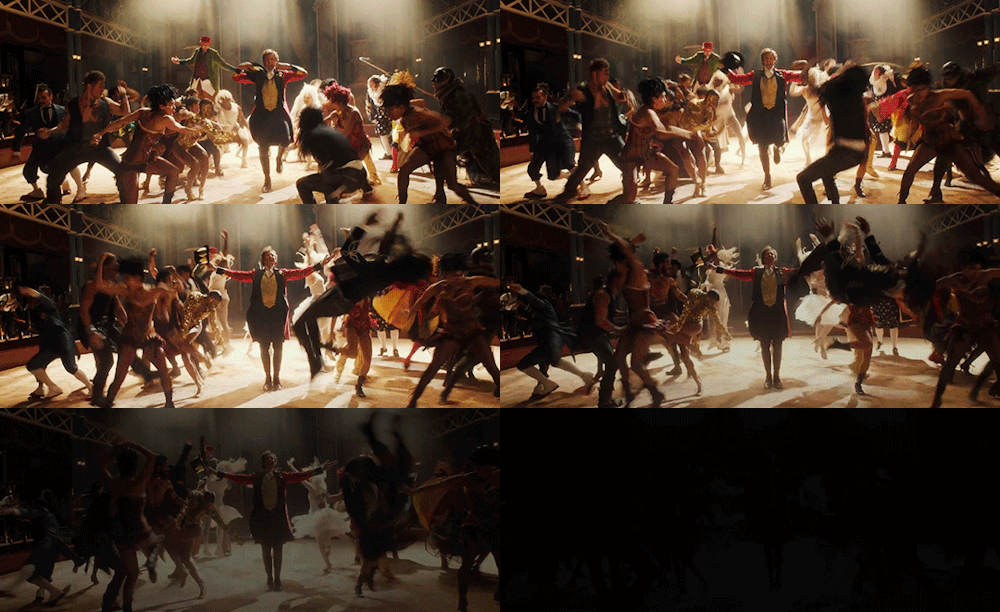
When it comes to being exactly what it’s intended to be, a musical, The Greatest Showman fully succeeds at being one thanks to a strong visual style and excellently choreographed musical numbers. And it’s all bolstered by an excellent ensemble cast highlighted by Hugh Jackman in the role of P.T. Barnum. Despite what I said earlier about how the film portrays him in a radically different light, Jackman is charismatic as always as he perfectly conveys Barnum’s showman skills that were noted in an interview as being reminiscent of former Apple CEO Steve Jobs’ showmanship. Jackman also has excellent chemistry with Michelle Williams, who plays Barnum’s loving wife Charity, and while that basically sums up her role in the film in a nutshell, like all her other onscreen performances Williams handles it greatly for what is basically her first major role in an onscreen musical. Another big standout is Zac Efron, who plays a playwright named Phillip Carlyle who becomes Barnum’s main business partner (in other words, he’s meant to represent Barnum’s real-life business partner, James Anthony Bailey). He too is incredibly charismatic while also having solid chemistry with Zendaya, who plays a trapeze artist named Anne Wheeler who he falls in love with. And when it comes to the film’s biggest standout, look no further than Broadway veteran Keala Settle as ‘the Bearded Lady’, who headlines the film’s main song ‘This is Me’. On that note, this film’s biggest strength is its soundtrack. Alongside ‘This is Me’, whose sequence in the film is an undisputed highlight, other standout tunes include ‘The Other Side’, performed by Jackman and Efron during the scene where Barnum tries to convince Carlyle to join the circus, and the film’s show-stopping opening/closing number, ‘The Greatest Show’. Because of all this, The Greatest Showman is easily shaping up to be one of the most underrated films of this past year. Sure, it may not exactly be historically accurate, but if you’re just looking for an entertaining musical that both kids and adults can enjoy, then I’m sure that you’ll be more than satisfied with this film.
To be perfectly blunt, 2017 was not that good of a year for the animation genre. While there were solid hits like Captain Underpants and Cars 3, there were also some major stinkers like The Nut Job 2: Nutty by Nature and, of course, The Emoji Movie. Thus, leave it to old reliable, Pixar, to give us what is easily the best animated film of the year.
8. COCO
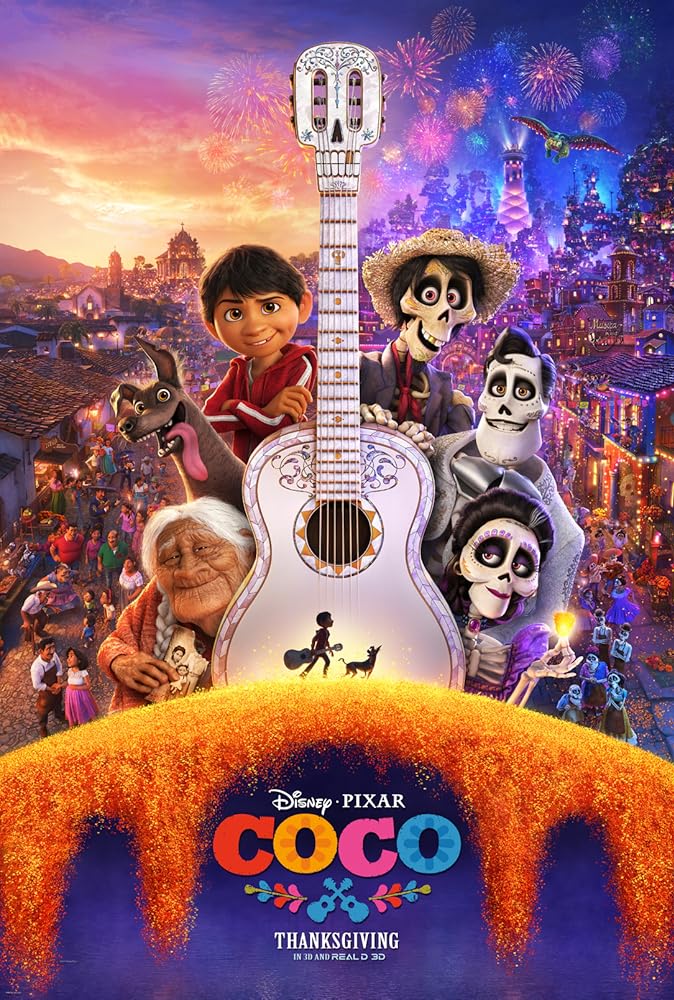
Coco served as the latest directorial outing for longtime Pixar filmmaker Lee Unkrich. Having been involved with Pixar ever since they started making feature films, Unkrich first got his start as one of their primary editors before being promoted to the position of co-director on films like Toy Story 2, Monsters Inc., and Finding Nemo. He was finally promoted to the role of the main director on Pixar’s big critical/commercial sensation Toy Story 3, one of only three animated films that got nominated for Best Picture at the Academy Awards. And for his latest film, Coco, Unkrich takes us on a journey that is inspired by the most famous Mexican holiday of all-time, Día de Muertos AKA the Day of the Dead. However, there was some initial skepticism amongst those who were fearful about Pixar’s handling of such an important aspect of Mexican culture, especially after Pixar’s parent company Disney tried to acquire the trademark for the phrase ‘Día de Los Muertos’. Thankfully, these fears were ultimately proven unfounded, as Coco treats its subject matter with the respect that it deserves. Of course, like any great Pixar film, Coco boasts gorgeous animation that brings the world of the Land of the Dead to life in so many great ways. The film also features a great ensemble cast of characters headlined by the likable main protagonist Miguel and the charismatic Land of the Dead trickster Hector. Newcomer Anthony Gonzalez and Gael Garcia Bernal are both excellent in their respective roles while also being backed by a solid supporting cast that includes Benjamin Bratt as famous musician Ernesto de la Cruz and Alanna Ubach as Miguel’s stern but caring great-great grandmother Imelda.
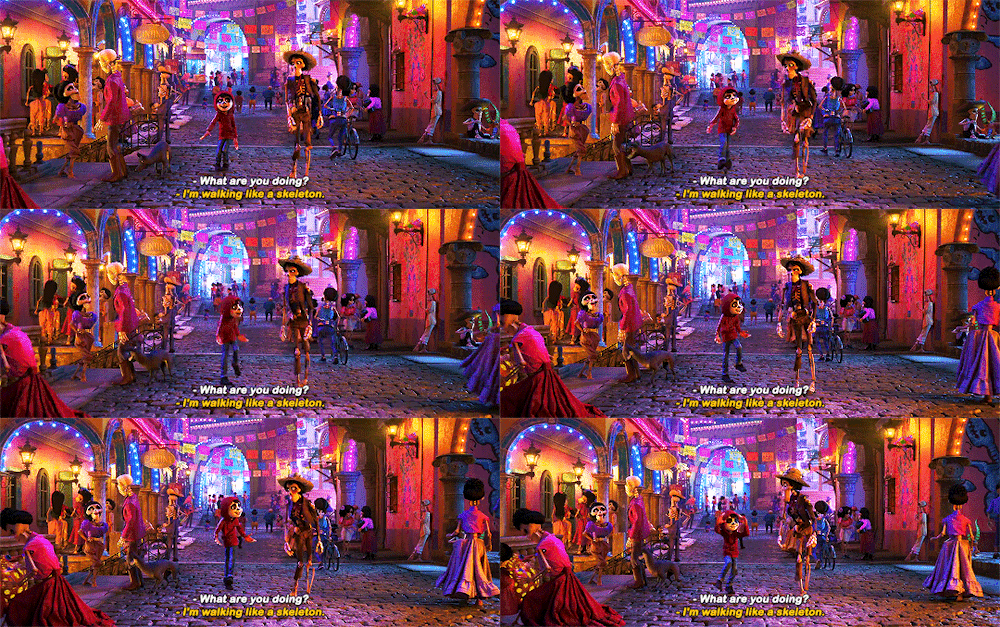
But, of course, also like any great Pixar film, Coco is bolstered by an emotionally poignant story that is tied to the most important aspect of the Día de Muertos ceremonies, the importance of family. The bulk of the film’s plot revolves around Miguel trying to prove to his family that he’s meant to be a musician despite his family’s decades-long ban on music after his great-great-grandfather left to pursue a career in music. Miguel is then led to believe that his great-great-grandfather is none other than the legendary Ernesto de la Cruz, which eventually leads to him traveling to the Land of the Dead in the hopes of finding his idol to help prove his family wrong. However, Miguel soon learns that his idol is not who he’s cracked up to be (a plot twist that ironically ended up mirroring real life after Pixar CEO John Lasseter became tied to the ‘Weinstein effect’ epidemic) and that Hector is his real great-great-grandfather. And while Miguel has spent much of the film trying to distance himself from his music-hating family, they end up becoming vital to his efforts of exposing de la Cruz’s secrets, namely how he poisoned Hector, the real creative force behind his music, when the latter tried to return to his family. This, of course, then leads to the biggest emotional moment in the film in which Miguel saves Hector from being forgotten in the Land of the Living by singing ‘Remember Me’, a song that Hector had written for his daughter, to his great-grandmother Coco. Though I must add that Hector’s own performance of the song to the infant Coco in a flashback prior to the moment when he left to pursue his career in music is another great emotional moment as well. Bottom line, Coco is an effectively emotional film, making it one of the purest examples of why Pixar has continued to be one of the most dominant animation studios in the entire industry.
Over the past few years, we’ve been treated to one of the most surprisingly effective franchise revivals thanks to the return of a long-running sci-fi franchise, which continued this year with another emotionally powerful blockbuster.

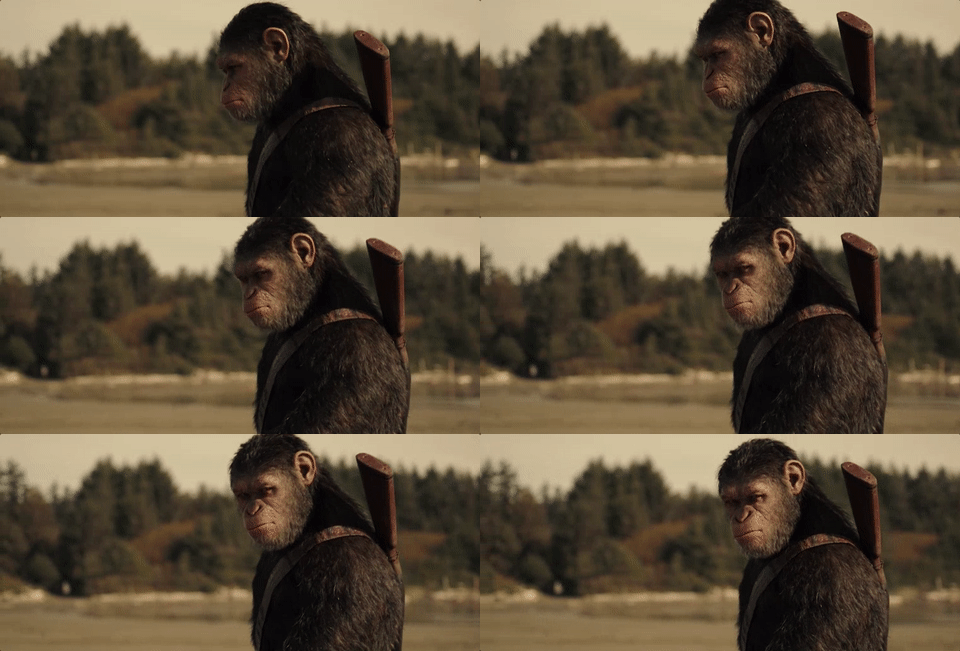
2011’s Rise of the Planet of the Apes was easily one of the most surprisingly good releases of that year. Featuring new advancements in the art of performance-capture visual effects and a terrific performance from mo-cap king Andy Serkis in the role of the intelligent ape Caesar, the film was a solid critical/commercial hit and was lauded for its emotional depth. This was then followed by a superior sequel in 2014’s Dawn of the Planet of the Apes, where director Matt Reeves managed to up the emotional depth of Rise to even greater levels, resulting in a film where the story and characters were just as well-handled as its amazing visual effects. Sure enough, this hot streak for the franchise managed to continue with the third entry in the reboot series, War for the Planet of the Apes. Reeves returns as director and once again does a phenomenal job of balancing the impressive visuals with an emotionally-charged plot and well-layered characters. For one thing, War is arguably the darkest entry in the series to date, as it involves Caesar embarking on a quest for revenge against a vicious colonel and his military faction Alpha-Omega after the former kills his wife Cornelia and his older son Blue Eyes. Along the way, Caesar is also haunted by the events of Dawn, namely the fact that he was forced to kill his traitorous former ally Koba who returns in this film via a series of hallucinations. But while the film certainly maintains a grim tone throughout, there are some elements in it that help to lighten the mood at the right times, namely Steve Zahn’s ‘Bad Ape’ who gets a lot of the best humorous moments in the film (e.g. when he’s looking through a pair of binoculars the wrong way (“Oh no! Why so Small?”))
One of the best aspects of Dawn was how there was a good balance in terms of character development for both the human and ape characters. This was best reflected in Gary Oldman’s character Dreyfus who, despite serving as an ‘enemy’ of the apes, wasn’t necessarily an antagonistic figure. And while Woody Harrelson’s Colonel is by no means a ‘sympathetic’ character, War does continue the franchise’s recent trend of making its main human characters just as well-layered as the apes. Harrelson does a phenomenal job as the film’s main antagonist, who is so relentless in his efforts to wipe out the apes that he even executes his own men when they became infected with a mutated strain of the Simian Flu that started this whole conflict in the first place. This brings us to the other big human character in the film, a mute young girl (Amiah Miller) who was affected by the Simian Flu. She ends up becoming a friend of the Apes and is later named ‘Nova’ by her new ‘guardian’, Caesar’s loyal adviser Maurice. And yes, fans of the franchise will no doubt recognize that name as she is the younger self of Linda Harrison’s character from the original Planet of the Apes. But, of course, at the end of the day, War for the Planet of the Apes’ main purpose is to serve as a perfect conclusion to the arc of Caesar. After managing to save his fellow Apes from Alpha-Omega, Caesar dies peacefully from the injuries that he sustained during the battle after Maurice assures him that his son Cornelius “will know who was father”. With that in mind, I’m curious as to how this series may potentially continue after this. Could we possibly end up getting a new take on the original Planet of the Apes story in which an astronaut returns to Earth unaware that it has been taken over by apes? This plot-thread was potentially established in Rise, after all, and despite Caesar’s death in this film, there’s a possibility for Serkis to return for this supposed fourth film albeit in a different role (e.g. a fully grown-up Cornelius). Ultimately, though, if this truly is the last installment of the reboot series, then at the very least it went out on the best note possible.
And that’s the end of Part 2 of Rhode Island Movie Corner’s annual ‘Favorite Films of the Year’ list. Thanks for following along and be sure to check back in tomorrow for Part 3, in which I’ll be listing films #6-4.

