Showing posts with label Millie Bobby Brown. Show all posts

Thursday, April 15, 2021

Godzilla vs. Kong (2021) review (HBO Max)


‘Creature features’ have been a staple of film for many decades, and when it comes to this particular genre, there are two cinematic monsters who reign supreme. First, there was King Kong, the titular 24-foot-tall prehistoric gorilla, dubbed the ‘Eighth Wonder of the World’, who debuted in the 1933 film of the same name directed by Merian C. Cooper and Ernest B. Schoedsack. With groundbreaking stop-motion effects by Willis O’Brien and an iconic finale in which the title character scales the Empire State Building, King Kong quickly became one of the most highly regarded films of all time, undoubtedly inspiring numerous generations of filmmakers. Case in point, in 1954, another giant monster came onto the scene known as Gojira, a 164-foot-tall radioactive reptilian beast. Created in the wake of the bombings of Hiroshima and Nagasaki at the tail-end of World War II, Godzilla (which is the character’s English-translated name) also became a landmark for both the monster genre and the art of special effects while simultaneously revolutionizing the genre of Japanese giant monster films AKA Kaiju films. Following their quintessential debuts, both characters would go on to appear in several other films over the years. The original King Kong, for example, was notably remade twice; one in 1976 starring Jeff Bridges and Jessica Lange and the other in 2005 directed by Peter Jackson. As for Godzilla, he would end up appearing in a whole bunch of follow-ups with the character’s parent company, Toho, producing over 30 sequels that span 4 distinct eras and saw the King of the Monsters face off against new and exciting creatures such as King Ghidorah and Mothra.  

But while these two towering icons have mostly operated on their own accord, they did notably appear together on-screen in Godzilla’s third official cinematic outing, 1962’s King Kong vs. Godzilla. Primarily spawned from a story outline from Willis O’Brien that had King Kong fighting a giant-sized version of the Frankenstein monster, this concept evolved into a figurative and literal ‘clash of the titans’ that ended up being one of the Godzilla franchise’s most popular installments. But now, nearly six decades after the original’s debut, the ‘King of the Monsters’ and ‘The Eighth Wonder of the World’ are back at it again in Godzilla vs. Kong, the latest installment of Warner Bros. and Legendary Pictures’ MonsterVerse series which reimagined the titular characters for a worldwide audience. It all began, of course, in 2014 with the release of the second attempt at an American-made adaptation of Godzilla after the infamous 1998 adaptation directed by Roland Emmerich. A sequel would follow in 2019, Godzilla: King of the Monsters, while King Kong headlined his own cinematic reboot two years prior with Kong: Skull Island. For this latest installment of the franchise, directorial duties go to Adam Wingard who, like his immediate predecessor Michael Dougherty (who directed King of the Monsters and has a story credit for this film), is mainly known for his work in the horror genre, having directed films such as the 2011 slasher You’re Next and the 2014 thriller The Guest. In short, it goes without saying that this has been one of the most anticipated films in recent memory, and while there are plenty of instances where it showcases some of the MonsterVerse’s most common shortcomings, Godzilla vs. Kong still manages to be a delightfully entertaining crossover event.   

With humanity now fully aware of the existence of gigantic creatures known as ‘Titans’, much of their attention has been geared towards learning more about the Titans’ homeworld, Hollow Earth, that’s hidden directly underneath the planet’s surface. This includes Walter Simmons (Demián Bichir), the CEO of tech conglomerate Apex Cybernetics, who recruits geologist Nathan Lind (Alexander Skarsgård), a former member of the Titan-studying organization Monarch, for a mission to travel to Hollow Earth and retrieve a power source that they could potentially use to deal with Godzilla, who has recently been on a series of inexplicable rampages around the world. As part of the operation, Lind recruits Monarch linguist Dr. Ilene Andrews (Rebecca Hall), who has been monitoring the apex predator of the mysterious Skull Island, Kong, and has also been looking after the island’s last native, Jia (Kaylee Hottle), a young deaf girl who has a unique friendship with Kong. But, as to be expected, their journey to Hollow Earth soon results in Kong crossing paths with Godzilla, thus putting Lind and his team in a time-sensitive situation as they race to give Kong a fighting chance against his incredibly imposing adversary. Meanwhile, Madison Russell (Millie Bobby Brown), her best friend Josh Valentine (Julian Dennison), and conspiracy theorist Bernie Hayes (Brian Tyree Henry) go undercover to investigate into Godzilla’s recent attacks, which leads to them uncovering a sinister plot by Apex that could result in devastating effects for both them and the Titans.

Godzilla vs Kong knows exactly what kind of film you’re here to see, and as always, this franchise more than delivers when it comes to its monster-based action sequences. In fact, this one even manages to surpass all its predecessors, especially the Godzilla films, by having multiple sequences take place during the day rather than at night, and even when they do have a night-time action sequence, they’re lit far better than the ones from previous films. Tonally, this film is more in line with the generally light-hearted Kong: Skull Island rather than the more serious Godzilla films, and while it is admittedly a bit jarring to see the returning characters from Godzilla: King of the Monsters partake in some of this film’s wackier antics, it’s also arguably a far better route to go for a film of this nature. However, as entertaining as this film is, it goes without saying that it maintains one of the most recurring problems that the MonsterVerse has faced over the years in that all that great action can’t entirely make up for its mediocre plot. In this instance, we have what is probably the franchise’s most sci-fi heavy premise to date given everything revolving around Apex Cybernetics and the journey to Hollow Earth… and yet, it still manages to feel like a complete afterthought with a bunch of extraneous characters and plotlines. But like I just said earlier, the fact that this film is more upbeat in tone than the previous films helps to alleviate much of that since, at the very least, it’s not trying to take itself too seriously.    

As always, the human element of the MonsterVerse films has never been the point of the franchise. Case in point, Godzilla vs. Kong follows in the footsteps of Kong: Skull Island and Godzilla: King of the Monsters by featuring an impressively stacked ensemble cast… and doesn’t really give any of them anything of value to work with. Still, for what it’s worth, I do think that this film handles the human side of its story better than King of the Monsters, where I’d argue that the human plot was even more poorly executed than usual. Obviously, Godzilla vs. Kong isn’t that much better by comparison, but there are a few decent character moments here and there, namely via the friendship between Kong, who’s basically the main character of the film, and Jia, the last surviving member of Skull Island’s Iwi natives. Newcomer Kaylee Hottle and Rebecca Hall headline the film nicely as Jia and her adoptive mother Ilene, respectively, in what is probably the franchise’s best example of human characters who have a strong connection with one of the title characters. Everyone else in the cast from Alexander Skarsgård to Brian Tyree Henry is just there, for the most part, but they work well enough with what they get. This includes the returning Millie Bobby Brown and Kyle Chandler from King of the Monsters as Madison Russell and her father Mark, and while Chandler is sadly limited to an extremely minor supporting role this time around, Brown thankfully isn’t sidelined like she was for most of the previous film. Granted, her role here is arguably the most prominent case of the film’s ‘extraneous’ plotlines, but at the very least, she does get more to do this time around.      

If you’ve been following this site for a while, you might recall that my thoughts on the MonsterVerse have varied considerably from film to film. Overall, I thought that the first Godzilla from 2014 was a solid kick-starter for a new cinematic universe style franchise a la the MCU. Sure, it didn’t have much of the title character and the main human protagonist was the very definition of a bland and generic lead but at the very least, director Gareth Edwards did a fantastic job of mirroring the serious tone of the original Godzilla film from 1954, especially when compared to the franchise’s campier follow-ups. As for 2017’s Kong: Skull Island, it’s easily my favorite of the first three MonsterVerse films. While it was arguably a major case of style over substance, its unabashedly extravagant visual style helped make this full-on homage to 1970’s war films an incredibly entertaining watch. Conversely, the second of the MonsterVerse’s Godzilla films, 2019’s Godzilla: King of the Monsters, was a film that, unfortunately, I wasn’t too big on when it first came out, and upon my most recent re-watch… well, nothing’s really changed on my end. Granted, I fully understand why this film became such a hit with fans of the franchise, namely due to how it delivered on many of the things that they didn’t get from the first film such as the sight of Godzilla fighting some of his most iconic adversaries such as King Ghidorah. Overall, though, the film suffered immensely from some incredibly sluggish pacing, and while the lack of any decent character development is to be expected from this franchise, this is one instance where I’d argue that the human side of the story almost derailed it entirely.

I’m happy to report, however, that I’m far more positive towards Godzilla vs. Kong, which is basically the cinematic embodiment of the MonsterVerse franchise in a nutshell. From a visual perspective, it goes above and beyond to present some of the most exciting action sequences involving cinema’s most iconic monsters. But from a narrative perspective, it’s barely held together by a bare-bones plot, and while the film does boast an excellent cast, said cast is just there to help move things along. Thus, at the end of the day, it ultimately comes down to how everything came together in the end, and this is where I’d argue that this film turned out to be a lot better than Godzilla: King of the Monsters, especially when it comes to these films’ overall tone. Whereas King of the Monsters took itself a bit too seriously, Godzilla vs. Kong fully understands that what we’re mainly here to see is the awesome sight of a giant monkey punching a giant lizard in the face. Thus, while it’s undoubtedly the MonsterVerse’s most undemanding installment to date, its lighthearted tone and far more vibrant color palette compared to some of the other installments of the franchise helps to make up for the usual narrative shortcomings, for the most part. In other words, Godzilla vs. Kong is an incredibly fun popcorn flick whether you’re watching it at home via HBO Max as part of Warner Bros.’ simultaneous theatrical/streaming plan for its 2021 releases or in theaters, where it has arguably been the most successful blockbuster that’s been released since the start of the COVID-19 pandemic.     

Rating: 4/5

Thursday, June 6, 2019

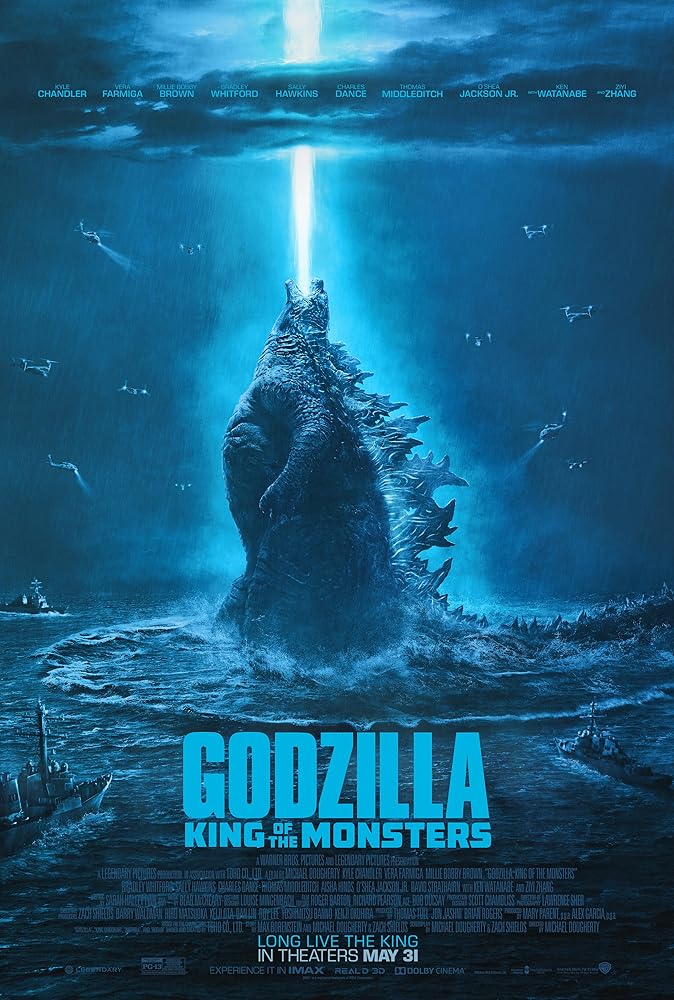
Godzilla: King of the Monsters (2019) review


Godzilla: King of the Monsters (2019)

When it comes to the most iconic monsters in film history, none arguably stand taller (figuratively AND literally) than the gigantic reptilian creature known as Gojira AKA Godzilla. Ever since he first hit the big screen in 1954 with his titular film debut, Godzilla has become a staple of pop culture thanks to his numerous film appearances courtesy of Toho Co., Ltd. As of 2019, there have been 32 official installments in Toho’s Godzilla franchise that span over the course of four separate eras. However, for many years, Godzilla wasn’t exactly as popular in the U.S. as he was in Japan. While several installments of the series did see a U.S. release either via a traditional American redub or substantial re-edit (e.g. Godzilla, King of the Monsters, the 1956 U.S. release of the original 1954 Godzilla film), others didn’t see a proper domestic release until they were released on home video several years later. It wasn’t until 1998 when the character was finally given a film adaptation that was primarily geared towards U.S. audiences. 1998’s Godzilla was directed by Roland Emmerich and did generally well at the box-office upon its release, grossing over $300 million worldwide. However, it was ultimately a major dud with both critics and audiences, with many fans lamenting the fact that this version of Godzilla barely resembled the character due to its drastically different design and general lack of the character’s traditional abilities (e.g. his atomic breath). Instead, many felt that the film was blatantly trying to match the success of Jurassic Park, right down to a finale that copied several key elements from Steven Spielberg’s 1993 classic. Toho wasn’t too happy about the film, either, to the point that, when the character appeared in 2004’s Godzilla: Final Wars, it was renamed ‘Zilla’.

The next big attempt at an Americanized version of Godzilla came in 2014 from director Gareth Edwards. Compared to the 1998 film, the 2014 Godzilla made a considerable effort to create a far more accurate rendition of the title character, and for fans of the franchise, it seems as if the film managed to succeed at doing just that. However, while the film was a solid success with critics and audiences and grossed over $500 million worldwide, it turned out to be rather polarizing due to its overall handling of Godzilla, namely because of his general lack of screen-time in favor of the film’s less interesting human characters. But now the King of the Monsters is back in the fittingly titled Godzilla: King of the Monsters, and while it’s only the second of these recent Godzilla films, it’s the third installment of an ever-expanding cinematic universe known as the MonsterVerse. This new series also initiated a reboot of the King Kong franchise with 2017’s Kong: Skull Island, and these two iconic creatures are set to duke it out in a 2020 crossover, Godzilla vs. Kong. But first, we have the second Godzilla film, which sees the title character interacting with several of his iconic monster co-stars from previous Godzilla films, including Mothra, Rodan, and King Ghidorah. This time, directorial duties go to Michael Dougherty, a long-time screenwriter whose writing credits include a pair of X-Men films (2003’s X2: X-Men United and 2016’s X-Men: Apocalypse) and 2006’s Superman Returns. He made his feature-length directorial debut in 2007 with the horror anthology flick Trick ‘r Treat, which has since gone onto become a cult classic of the horror genre along with his 2015 effort, Krampus. And yet, despite his best efforts, Godzilla: King of the Monsters doesn’t quite live up to its goal of fixing some of the biggest issues that fans had with its 2014 predecessor.

It has been five years since the events of the original Godzilla. After the incident in San Francisco where the city was ravaged by Godzilla and a pair of creatures known as MUTO’s, the secret government organization known as Monarch has been pressured into revealing what they know about the existence of these monstrous creatures, who they refer to as ‘Titans’. During this time, Monarch paleobiologist Emma Russell (Vera Farmiga) attempts to establish a method of communicating with the Titans via a device known as the ‘Orca’ that can replicate their vocal frequencies. However, while monitoring the birth of a giant larva, Mothra, Emma and her daughter Madison (Millie Bobby Brown) end up getting captured by a group of eco-terrorists led by former British Army colonel Alan Jonah (Charles Dance). Utilizing Emma’s device, Jonah plans on unleashing all Titans on Earth as a way of bringing balance to the natural order when it becomes apparent that humanity will end up causing their own demise. This results in various monsters being unleashed including the ‘Fire Demon’ Rodan and the most dangerous of the bunch, ‘Monster Zero’ AKA King Ghidorah, the Three-Headed Dragon. To undo Jonah’s actions, Monarch recruits the help of Mark Russell (Kyle Chandler), Emma’s ex-husband and Madison’s father, since he had a hand in developing the Orca prior to their divorce. But, of course, it’s only a matter of time before the one and only Godzilla gets involved as well.

One of the biggest complaints towards the previous Godzilla film was its overall lack of monster-related action. While it did have some genuinely incredible sequences of Godzilla fighting the MUTO’s, these scenes didn’t really occur until the end of the film, and any scenes where they fought beforehand ended up cutting away from the action right before they got started. Thus, fans will be happy to know that it’s an entirely different story with this new film. For starters, there aren’t any noticeable instances where the film cuts away from a monster fight that’s about to happen, and there are also a lot more scenes of Godzilla fighting the likes of King Ghidorah and Rodan rather than just a single fight between them all near the end. Simply put, the monster fights in this film are excellent and are matched by some equally terrific visuals… and yet, it still feels like the film doesn’t focus on its monsters as much as it should. Like the previous film, it tries to balance out the monsters with its human characters but ultimately focuses more on the latter. It also doesn’t help that this film’s plot can be quite a mess at times. Whether it’s because of a completely extraneous human villain or a heavily uneven tone that often makes it way too serious for a film of this nature, the film ends up having an extremely sluggish pace at times since most of the scenes with the humans are just exposition dumps.

This whole ‘focusing more on the humans than the monsters’ thing was another big issue that fans had with the 2014 film as they found the main human characters (namely, Aaron Taylor-Johnson’s Lt. Ford Brody) to be incredibly bland save for Bryan Cranston’s Joe Brody, who gets killed off very early on. And yet, to that film’s credit, Ford Brody was always the main character rather than it trying to focus on several characters at once. By comparison, King of the Monsters has a very stacked ensemble cast on par with the big ensemble of Kong: Skull Island, and while everyone’s fine in their respective roles, most of them have little to work with because of the incredibly convoluted narrative. From this cast, Kyle Chandler is arguably the most developed of the bunch (even though that’s not really saying much) as Mark Russell since the plot revolves around him trying to rescue his ex-wife Emma and their daughter Madison. Had the film primarily maintained focus on those relationships, there probably could’ve been some decent emotional depth to tie into the larger monster story. Instead, Vera Farmiga is tragically undermined by her character’s confused motives while Millie Bobby Brown surprisingly gets little to do despite having plenty of experience dealing with monsters thanks to her role on Stranger Things. As for everyone else, they’re just ‘there’, from Ken Watanabe and Sally Hawkins reprising their roles from the previous film as Dr. Serizawa and his assistant Dr. Graham to Bradley Whitford as a wise-cracking crypto-sonographer and Charles Dance as the previously mentioned human antagonist who’s quite frankly completely unnecessary.  
         
Now, despite all that I’ve said in this review, I want to make it clear that if you’re a fan of the Godzilla franchise and you’re just going into this looking for some awesome monster action, then you’ll probably love this film. Instead of what happened with the 2014 film, where Godzilla had limited screen-time and only one major fight scene with monsters that weren’t even some of his most iconic foes, this film more than delivers when it comes to seeing some of the franchise’s most iconic monsters duke it out. However, as much as it tries to fix the issues that fans had with the 2014 film, it ultimately still feels like Godzilla and his fellow monsters are playing second-fiddle in their own film when it should really be the other way around. Like the previous film, King of the Monsters tends to focus more on its human characters but doesn’t give them any legitimate character development to work with in a film that also suffers from having an extremely underdeveloped plot. Because of this, I’d dare say that the 2014 film did a much better job handling the character of Godzilla. I’m not saying that it was perfect, by any means, but it could be argued that director Gareth Edwards’ ultimate intent was to pay homage to the original Godzilla from 1954 by treating its giant monster attacks in a serious manner. And at the end of the day, that film’s serious tone felt much more appropriate when compared to this film, which doesn’t quite leap at the prime opportunity that it had to revel in some of the Godzilla franchise’s more over-the-top antics. As such, I’m sorry to say that I found Godzilla: King of the Monsters to be rather underwhelming, and yet, that isn’t stopping me from looking forward to Godzilla vs. Kong in 2020. Let’s just hope that it ends up being a heck of a lot better than this one.

Rating: 2/5

Saturday, October 28, 2017

Stranger Things: Season 1 Review


(DISCLAIMER: THERE WILL BE SOME MINOR SPOILERS BUT NOTHING TOO MAJOR!)

In 1997, entrepreneurs Reed Hastings and Marc Randolph created the DVD-by-mail rental service known as Netflix. After a full decade of operations, the company then established its own video streaming service in 2007, allowing customers to watch their favorite films and TV shows whenever they want. And while the video streaming service is still going strong today thanks to its vast library of distributed content, nowadays Netflix has become known for producing its own line of films and TV shows. Many of these ‘Netflix Originals’ have gone on to attract considerable critical acclaim and have also covered a wide array of genres that have been geared towards an equally wide range of audiences, from the prison-set dramedy Orange is the New Black to the numerous shows that have been produced in conjunction with Marvel Studios. And in the summer of 2016, Netflix debuted a show that has gone on to become one of their most popular projects to date, Stranger Things. Created by Matt and Ross Duffer, AKA The Duffer Brothers, Stranger Things is a supernatural sci-fi horror series that’s heavily influenced by 80’s pop culture, most notably the works of director Stephen Spielberg and author Stephen King. And thus, with the highly anticipated second season premiering this weekend, it’s time to take a look at this cultural phenomenon which does, indeed, live up to all the hype that has surrounded it.  

The year is 1983. On a quiet fall night in the town of Hawkins, Indiana, a young boy named Will Byers (Noah Schnapp) suddenly disappears under mysterious circumstances. The following day, a statewide search is initiated by Hawkins Police Chief Jim Hopper (David Harbour), and despite the growing amount of evidence that suggests otherwise, Will’s mother Joyce (Winona Ryder) and his older brother Jonathan (Charlie Heaton) remain optimistic about the chances of him being found. During this difficult time, Will’s three best friends, Mike Wheeler (Finn Wolfhard), Dustin Henderson (Gaten Matarazzo), and Lucas Sinclair (Caleb McLaughlin) also get involved in the search as well. And as the lot of them soon find out, Will is somehow trapped in an alternate dimension known as the Upside Down where he is being pursued by a vicious monster, which obviously puts more pressure on his friends and family to rescue him before it’s too late. While all this is going on, a mysterious young girl who calls herself Eleven (Millie Bobby Brown) escapes from a nearby government facility. Mike, Dustin, and Lucas end up befriending her and discover that not only does she possess special telekinetic abilities, but that she may also prove to be vital to the process of rescuing Will from the Upside Down.


Now, admittedly, because I wasn’t around during the 80’s, I think it’s safe to say that I don’t have as strong of a connection to the various facets of pop culture that are referenced in this show compared to others. And yet, even with that said, you don’t have to be an 80’s kid to fully appreciate this series for all the great things that it does. Because while it’s obviously influenced by the likes of Stephen King and Steven Spielberg, with a King-like supernatural premise and the kid-oriented narrative that’s often seen in Spielberg films, Stranger Things is ultimately bolstered by a highly engaging story that’s fully steeped in emotional poignancy. Oh sure, this show’s got mysterious alternate dimensions, badass telekinetic children, and terrifying demonic creatures to satisfy the science-fiction and horror crowds, but at the end of the day, this show is mainly about a young boy who goes missing as his friends and family do whatever they can to find him. This ultimately ties into one of the main things that made several of the films and stories that this series is influenced by so memorable; they inserted fantastical elements into a grounded human story, allowing us to connect to the characters even when they get into crazy scenarios. And thanks to a solid visual aesthetic and a deeply-layered plot, the Duffer Brothers manage to give us a story that feels incredibly fresh even when considering everything that’s come before it.


Sure enough, one of the best elements of this show is that you do end up being as fully invested in its wide array of well-layered main characters as much as you do with the main plot, and this applies to each of the show’s 3 age-based tiers of protagonists. Starting off with Stranger Things’ excellent batch of young protagonists, Mike, Lucas, and Dustin are quite the endearing trio and they have terrific camaraderie with each other as they band together to find their friend Will. Of the three, Mike is arguably focused on the most due to the strong bond that he develops with Eleven that even ends up spawning a sweet little bit of ‘young love’. But that doesn’t mean that Lucas and Dustin don’t get as much quality material to work with, as Lucas gets a nice character arc revolving around his initial distrust of Eleven, which ends up causing a rift in his friendship with Mike, while Dustin serves as the lovable ‘middle man’ of the group. Plus, he also gets some of the best lines of dialogue (“I'm just going to get some chocolate pudding! I'm telling you, lunch lady Phyllis hoards that s***!”). Speaking of Eleven, Millie Bobby Brown is easily the biggest standout of the entire show as the badass but tragically sympathetic telekinetic child who loves to eat Eggo waffles. Brown conveys so much despite only having around 42 lines of dialogue, which are mostly made up of one-word exclamations like ‘mouth-breather’.


Moving over to the main teenaged characters of the story, there’s Jonathan, who gets just as involved as his mother does when it comes to searching for his younger brother, and Mike’s older sister Nancy (Natalia Dyer), who ends up becoming tied to the whole ordeal when her best friend Barb (Shannon Purser; and yes, as everyone else on the internet has said, Barb is a memorable supporting character despite only appearing in about three episodes) disappears as well. The two of them eventually team up to deal with the situation, and despite that one creeper scene early on in the season when Jonathan takes pictures of Nancy and her friends while at a party (don’t worry, he improves after that…), they do share a nice chemistry that could potentially blossom into something else in future seasons. Finally, there are the two main adults of the series, Joyce Byers and Chief Jim Hopper. Admittedly, some of Joyce’s early ravings come off as being perhaps a bit too hysterical, but that does go away as the season goes on (e.g. the powerful scene in Episode 4, ‘The Body’, where she insists that Will is still alive even after a body is found). And if anything, Winona Ryder absolutely owns the role of a mother who’s fully devoted to finding her son no matter what. As for Hopper, David Harbour is great as well as the alcoholic police chief who, as we come to learn, suffered an immensely devastating personal tragedy a few years prior. Said tragedy is shown in the final episode of the season, ‘The Upside Down’, where it’s intercut perfectly with another highly emotional moment. In fact, there were a lot of great emotional moments in that episode, hence why it ended up being my favorite episode of the season.


Well, there’s not much else that I need to say about this series other than the fact that if you haven’t seen it yet, I highly encourage you to give it a watch. Like I said before, you don’t have to be an 80’s kid to fully appreciate everything that’s great about this show. With that said, though, if you are an 80’s kid, then this show delivers an excellent dose of 80’s nostalgia thanks in large part to the various bits of pop culture that it’s heavily influenced by. But at the same time, this show also delivers thanks to its strong and emotional story that’s mainly based around a down-to-earth plot of a young boy’s disappearance and the desperate search efforts made by his friends and family to find him. And this story is further elevated by a terrific ensemble cast portraying an excellent collection of likable characters that are just as well-developed as the plot. In short, it’s easy to see why this show has been such a hit amongst critics and audiences during a time where a nostalgic passion for classic films and TV shows is at an all-time high, and I look forward to seeing what happens next in the town of Hawkins, Indiana in Season 2.

Season 1 Rating: 5/5!


And that’s my review of Season 1 of Stranger Things. Thanks for following along and you can look forward to a review of Season 2 sometime in the next few weeks.