Showing posts with label George Clooney. Show all posts

Friday, August 18, 2017

Ocean's Trilogy Retrospective

Image result for ocean's eleven

There is a lot of hype surrounding one of this weekend’s new releases, Logan Lucky. And one of the reasons why is because of who it’s directed by; none other than director Steven Soderbergh. This film serves as a much-heralded return to the big-screen for the director, who ‘retired’ from directing feature films in 2013. Prior to that, Soderbergh had made quite a name for himself in the film industry through his work on various projects. These have ranged from indie flicks like 1989’s Sex, Lies, and Videotape to A-list releases like his pair of efforts from 2000, Erin Brockovich and Traffic, the latter of which won him the Oscar for Best Director at that year’s ceremony. However, just like with Kathryn Bigelow’s Detroit earlier this month, today I won’t be doing a full directorial retrospective on Soderbergh’s work because, once again, I don’t have enough time to watch all his films to get this out in time for Logan Lucky. Instead, today we’ll be looking at one of his most famous directorial efforts, the Ocean’s trilogy. The first of these three films, 2001’s Ocean’s Eleven, was a remake of a 1960 film of the same name. The original film featured an all-star ensemble cast highlighted by several members of the era’s iconic ‘group’ of entertainers known as the ‘Rat Pack’, including Frank Sinatra, Dean Martin, Sammy Davis Jr., etc. The remake features an equally stacked ensemble cast that includes the likes of George Clooney, Brad Pitt, Matt Damon, Don Cheadle, and Julia Roberts… and that’s just to name a few. And while the critical reception of this series has varied with each release, all three films have been solid commercial hits with a combined total of over $1.1 billion earned at the box-office. There’s even a spin-off in the works directed by Gary Ross, Ocean’s Eight, which will be headlined by an all-female cast. Today, though, it’s time to hit the casinos and tag along with the charismatic Danny Ocean and his crew as we look back at Steven Soderbergh’s Ocean’s trilogy.

OCEAN’S ELEVEN (2001)


In Ocean’s Eleven, George Clooney stars as Danny Ocean, a charming thief who’s just been released from prison. As soon as he gets out, he enlists 10 of his old associates for a heist on three of Vegas’ biggest casinos; the Bellagio, the Mirage, and the MGM Grand. All three are owned by Terry Benedict (Andy Garcia), who just so happens to be dating Danny’s ex-wife Tess (Julia Roberts), which proves to be one of the main reasons why Danny is undertaking this operation. And really, that’s all that this film has in terms of its plot; at the end of the day, it’s just a simple heist story with minimal character development. Aside from Danny, Tess, his best friend Rusty (Brad Pitt), and ‘rookie’ Linus Caldwell (Matt Damon), everyone else is mostly just ‘there’, meaning that there’s not much emotional weight to these proceedings. With that said, though, when the film delivers on exactly what the audience came for (i.e. the heist), that’s where it really shines. Soderbergh does succeed at crafting a slick, stylish, and all-around fun heist thriller that benefits from some excellent cinematography by Peter Andrews… who is really Soderbergh. Yeah, Soderbergh’s one of those directors known for doing the cinematography and editing on their own films under a pseudonym. Anyway, as for the film’s cast, while it’s often been said that they’re mostly just mugging for the camera in these films which, to be fair, is kind of true, they’re still a lot of fun to watch and work off each other incredibly well. Thus, Ocean’s Eleven ultimately succeeds at being exactly what it is; an admittedly simple but overall fun thriller, nothing more, nothing less.

Rating: 4/5

OCEAN’S TWELVE (2004)

Image result for ocean's twelve poster

Steven Soderbergh has gone on record stating that Ocean’s Twelve is his personal favorite of the three Ocean’s films that he’s directed. However, he’s sort of in the minority on that one, as Ocean’s Twelve received mixed-to-negative reviews from critics and is generally considered to be the weakest of the trilogy. And overall… unfortunately, Mr. Soderbergh, I find that I agree with the critics on this one. Ocean’s Twelve is an oddly assembled sequel, as it doesn’t do much of what it’s meant to be about, heists. In fact, most of the main protagonists end up in jail at one point or another, meaning that they’re often separated from each other for most of the runtime which, therefore, goes against the series’ team dynamic. And despite starting out with what appears to be another simple heist plot, this film then goes all over the place in terms of its narrative, including the infamous scene where Danny’s wife Tess pretends to be Julia Roberts for a heist (just as a reminder, Tess is played by Julia Roberts). This scene, complete with a random Bruce Willis cameo, soon descends into complete absurdity, to the point where I genuinely got disoriented at one point as to just what the heck was going on in it. Now, in Soderbergh’s defense, I can at least understand as to why this is his favorite entry in the trilogy. Stylistically speaking, this entry in the series feels the most Soderbergh-esque, with experimental camera work (i.e. a TON of panning shots) and a meta vibe to the proceedings. In fact, it could be argued that, with this film, Soderbergh was going against the norms of a traditional Hollywood sequel. Still, I think that he was being a bit too experimental with this one, resulting in a frustrating film that doesn’t really have a lot of what made the first film so entertaining. Whereas that film left me entertained, this film just left me feeling empty.

Rating: 1.5/5

OCEAN’S THIRTEEN (2007)
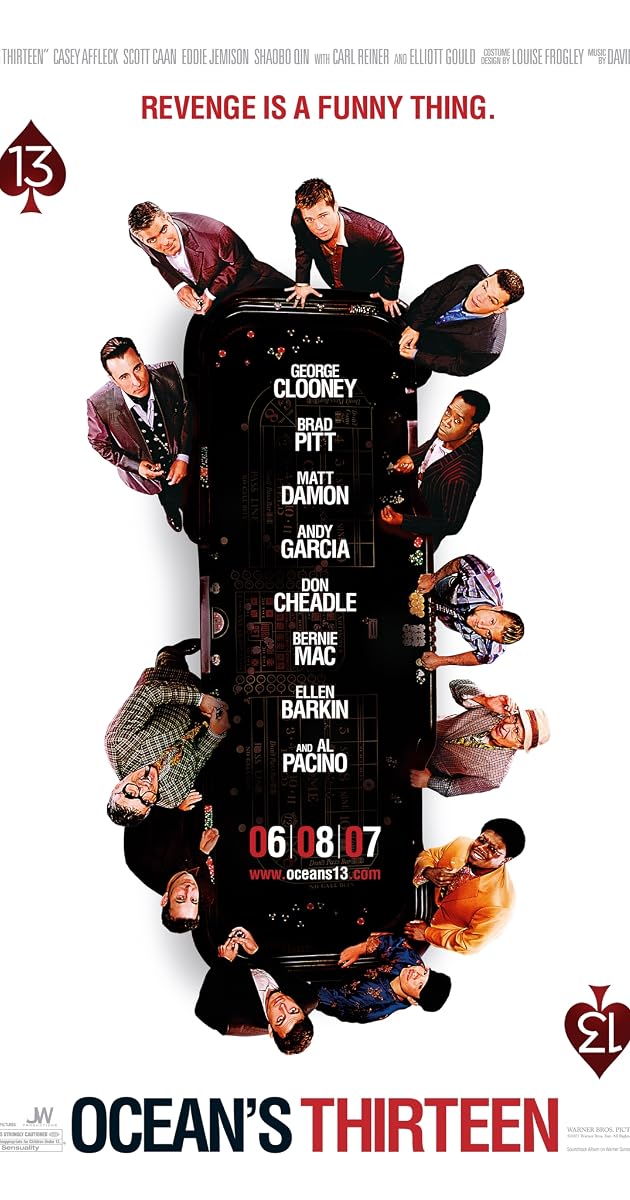
Image result for ocean's thirteen poster

After experimenting with Ocean’s Twelve to mixed results, Soderbergh returned to basics with the third and final installment of the trilogy, Ocean’s Thirteen… which makes it more of a superior sequel than its immediate predecessor. Now, sure, it could be argued that, by doing so, this makes the film more of a ‘safe’ sequel. However, this also means that, unlike the previous film, this film’s focus is exactly where it needs to be, and that is on Danny Ocean and co. and their heist. In fact, this film benefits from much stronger pacing compared to both the previous two films. Whereas those films started off slow to set things up, this film gets right into the action. Plus, while there wasn’t really anything to get emotionally attached to in either of the first two films’ plots, this one does, in fact, have more to it in terms of its emotional stakes. The main plot revolves around Danny and the gang attempting a heist on a new Vegas casino owned by hotel owner Willy Bank, a highly entertaining villain played by Al Pacino. This also happens to be more of a personal job for the group, as Bank had screwed over their ally Reuben (Elliott Gould) when building it. The film also does a nice job of showcasing how things have changed in the gaming industry since the original film. This ends up making things harder for the group during the heist, like when they must deal with the casino’s advanced computer system which can track the legitimacy of a player’s winnings. Granted, I’m not saying that all this makes the plot and character development that much better compared to what we saw before. But, thanks to what is easily Soderbergh’s best directing job on this entire trilogy, Ocean’s Thirteen ends up being the rare case in which a threequel is ultimately the best installment of its trilogy. Yeah, it’s mainly just popcorn entertainment, but when it’s this well-made, who am I to judge?


Rating: 4.5/5

Monday, May 16, 2016

Money Monster (2016) review


In describing the film Money Monster, I’m going to use a connection that I bet a few other critics have made as well in regards to the film. And that is the fact that this film shares quite a few similarities with the film Dog Day Afternoon, which I just so happened to have watched recently for a film class. Both films depict a stand-off situation that ends up becoming a nationally publicized event. And during this time, it is shown that the assailant actually isn’t really that much of a bad guy but instead just an average joe who’s down on his luck that’s committing said crime in order to take on those who wronged him. But whereas the main characters of Dog Day Afternoon were trying to rob a bank and basically kept messing it up, hence why the robbery in that film ended up turning into a standoff, the ‘criminal’ in Money Monster takes the host of a popular finance show hostage after a ‘tip’ that he got from a previous episode ended up majorly backfiring on him. What follows is a tense hostage situation revolving around a big bank conspiracy and a pretty darn well-directed and acted one at that. Director Jodie Foster, in her fourth foray behind the camera, gives us a film that not only succeeds in being a suspenseful thriller but also one that challenges the corruption of the U.S. economy, something that has clearly been on everyone’s minds in recent years (The Big Short, anyone?).

Lee Gates (George Clooney) is the host of the financial show ‘Money Monster’, which for years has been supervised by director Patty Fenn (Julia Roberts). About a month prior to the events of the film, Gates had suggested to viewers that they invest in IBIS Global Capital but the company’s stock ends up going kaput presumably due to a glitch in the trading algorithm that it runs on. And that ends up becoming a problem not only for the investors, who collectively lose around $800 million, but for Lee and the crew of ‘Money Monster’ as well. In the middle of a broadcast one day after the IBIS stock crash, a mysterious ‘deliveryman’ walks onto set with a gun. The ‘deliveryman’, Kyle Budwell (Jack O’Connell), takes Lee hostage and forces him to put on an explosive-laden vest. During this time, Kyle reveals that he was one of the many investors who got screwed over by the drop in IBIS’ stock, having invested his entire life savings, $60,000 to be precise, into it after following Lee’s advice. As both Lee and Patty try to keep things under control in the studio, as well as dealing with the police, led by Captain Marcus Powell (Giancarlo Esposito), once they arrive on the scene, they also begin to work with Kyle in order to figure out just what went wrong with IBIS’ stock. And as it turns out, there’s a lot more to this situation than just a supposed ‘algorithm glitch’.

Money Monster definitely delivers in terms of being a tense ‘claustrophobic’ thriller, at least in regards to the scenes where Kyle is holding Lee hostage in the studio. These scenes are well directed and edited and very much do their job in establishing both urgency and a palpable sense of tension throughout. While Patty tries to keep everything under control by communicating with both Lee and Kyle from the control room, Lee attempts to reason with Kyle in order to calm him down so that he won’t take his finger off of the bomb’s detonator. These are easily the best scenes in the film and they also do a very nice job at keeping things as ‘realistic’ as possible. The film also does a good job of maintaining a fittingly serious tone throughout, though there are a few moments of humor that lighten the mood from time to time, especially one particular scene at the end that, without giving too much away, sees the internet poke fun at one specific moment from the climax. Admittedly, the sequences set outside the studio are where the film starts to falter just a bit. I can’t really explain why but the overall ‘conspiracy’ that the film is working towards in regards to what happened with IBIS’ stock isn’t really as strong as the conflict that takes place within the studio. With that said, though, the film should still be commended for its efforts in challenging the corruption of the economy. And in some ways that corruption even comes from shows like ‘Money Monster’, which influenced people like Kyle enough for them to make stupid mistakes with their money by making disastrous investments. 

One of the best things about both this film and Dog Day Afternoon is that both allow the audience to sympathize with their ‘main criminals’ even when taking their not-so-honorable actions into account. Because as noted earlier, despite the fact that Kyle is the ‘gunman’ in this situation, we can sympathize with him in regards to how his financial losses seriously affected him, partially exemplified by a particularly emotionally devastating scene in which his pregnant girlfriend publicly berates him on live TV. Moments like that are very effective and Jack O’Connell handles them all excellently. As expected, he’s backed by a pair of excellent performances from George Clooney and Julia Roberts. Clooney’s trademark charisma is definitely on display here even though his character in this film can be rather smug at times, as shown in the early scenes when he is hosting his show. But once the main plot kicks in and the character becomes Kyle’s hostage, Clooney also does a nice job in conveying Gates’ fear, like when he first puts on the explosive-laden jacket and claims that he’s about to have a heart attack. As for Roberts, she’s also great in a role that serves as the mediator in this hostage situation while also having a solid camaraderie with Clooney. Everyone else in the cast is good as well but because the scenes outside of the studio aren’t really as strong as the ones inside the studio, the real stars of the show are Clooney, Roberts, and O’Connell.

Overall, Money Monster is a very solid real-time thriller that, for the most part, does its job in regards to establishing tension. This of course comes from the primary conflict that emerges between Lee Gates, Patty Fenn, and Kyle Budwell during a live broadcast of Gates’ show ‘Money Monster’. And during this hostage situation, the film does a very honorable job at critiquing the corruption of Wall Street. It isn’t even afraid to point the finger at shows like ‘Money Monster’ for, in their way, having a hand in said corruption. However, the film does suffer a bit when it comes to scenes set outside the studio, with most of these scenes serving as the third act of the film. The conspiracy plot that the film ends up focusing on isn’t really as strong as the suspenseful in-studio conflict. It may have something to do with the fact that this film has a fairly brisk runtime of only 98 minutes. It could be argued that certain moments in the plot are rather rushed over, particularly during the final third of the film. But despite the film’s shortcomings, the lead trio of George Clooney, Julia Roberts, and Jack O’Connell all do excellent jobs in their respective roles and the scenes involving their characters in-studio do make up for it for the most part. The end result is a film that may not be one of the best of its genre but is still a well-directed effort from Jodie Foster that at least does its job at being a solid and entertaining popcorn flick.


Rating: 3.5/5

Saturday, May 23, 2015

Tomorrowland (2015) review

Tomorrowland poster.jpg

If I were to list my Top 10 favorite directors currently working today, Brad Bird would definitely be at the top of the list. While this former animator’s directorial filmography is rather short with only four films to his name before this year, he’s like Christopher Nolan or post-‘Alien 3’ David Fincher in that he’s yet to make a bad film. And quite frankly, all of his films are pretty much masterpieces. His directorial debut, ‘The Iron Giant’, unfortunately was a flop at the box-office when it was first released in 1999 but thankfully has gotten the attention it deserved in recent years. Thankfully his next two films were much bigger hits as he cranked out two of Pixar’s best films to date, 2004’s ‘The Incredibles’ and 2007’s ‘Ratatouille’. And in 2011, Bird made the bold leap from animation to live-action, immediately striking gold with his live-action debut, ‘Mission Impossible: Ghost Protocol’. Now he’s back with Disney and teaming up with ‘Lost’ creator Damon Lindelof for ‘Tomorrowland’. No, it’s not a film that’s based off of the themed land found in most Disney parks. It’s instead a tale of optimism inspired by Walt Disney’s vision of the future, resulting in a truly original film… that at the moment is getting generally trashed by critics. This film currently has just a 49% rating on Rotten Tomatoes. Well believe me when I say that this is not a ‘49% on RT’ film… far from it. It’s a bold, ambitious and, most of all, truly captivating sci-fi film that provides us something that we’ve sort of lost in recent years… hope.

During the 1964 New York World’s Fair, aspiring kid inventor Frank Walker (Thomas Robinson) tries to show off his newest invention, a jetpack, to the heads of the fair. While his creation is generally ignored, he attracts the attention of a young girl named Athena (Raffey Cassidy), who leads him to a futuristic utopia known as ‘Tomorrowland’. In the present day, optimistic teen Casey Newton (Britt Robertson), the daughter of one of NASA’s engineers (Tim McGraw), gets into trouble with the law when she attempts to prevent NASA from taking down the Cape Canaveral launch site. When she gets out on bail, she finds a mysterious pin among her things which, unbeknownst to her, was ‘given’ to her by Athena. When she touches it, she finds herself ‘transported’ to the same fantastical world of ‘Tomorrowland’. But after the pin ‘runs out of power’, she tries to find a way to ‘get back’. Her quest ends up leading her to the grown-up Frank (George Clooney), who’s become fairly pessimistic and disenchanted with the place as it is revealed that he got ‘kicked out’ some time ago. When the two of them suddenly find themselves being hunted by robotic ‘police’, Casey and Frank, along with Athena, begin searching for a way to return to Tomorrowland. Along the way, Casey soon learns that she could be ‘the one’ who is capable of fixing the future of Earth as we know it before time runs out.

First of all, let me make something clear. Despite being called ‘Tomorrowland’, this film is not about the theme park land that shares its name. In fact, I’m pretty sure that the futuristic utopia in this film is never once actually referred to by name as ‘Tomorrowland’. Not only that, but despite being inspired by Walt Disney’s ideas of the future, Disney himself isn’t brought up once by name either despite what certain advertisements of the film, especially an international trailer that made it seem like the theme park ‘was just a cover for the real thing’, may have claimed. So if you’re thinking that this is just nothing more than a ‘marketing gimmick’ by Disney to promote the company… it isn’t. Instead, ‘Tomorrowland’ is an enthralling sci-fi story based around the ideals of optimism and hope for the future, two things that have definitely been lacking in our current society in recent years.  At the same time, Bird and Lindelof also made sure not to rush into things too quickly when it came to the utopian world that they created. In other words, this film is more about the journey to the location than it actually is about the location itself. As a result, this film was solidly paced and had great build-up. I was completely engaged by it from start to finish.

On that note, let’s talk about the third act of this film, which has basically been the most divisive aspect of the film amongst critics. This seems to be a recurring thing with Damon Lindelof’s work… his endings always piss people off (see ‘Lost’ and ‘Star Trek Into Darkness’ for further proof of that). Now while I’ll concur that the final pay-off may not have necessarily been as strong as the filmmakers had hoped, personally I don’t see why this ending is ‘as bad’ as some people have been claiming it is. From what I’ve been reading online, apparently a lot of the backlash towards this ending is due to the reveal of who the main ‘villain’ is. But the thing is… I kind of already knew who it was going to be going in anyway because there were certain articles online that were building the character up as such. Ultimately, the real problem with this reveal is that the character in question only plays a generally minor role in the overall story. This character is seen at the beginning of the film and then is not seen again until the third act. So in short, this film’s villain is fairly underdeveloped. But it’s not like it ruins the movie or anything as everything else in the film more than makes up for it. It’s just like with the Marvel Cinematic Universe films and their villains. The villains of the MCU may not necessarily be the most memorable or well-written villains ever but it’s not like the films are supposed to be all about them. And to me the same rule applies with ‘Tomorrowland’. Everything else in the film is so great that I can forgive the film for not having the ‘best’ of endings.

This film just has so many great talented people working on it, both behind and in front of the camera. The latter of which is especially true when talking about this film’s excellent cast, especially its trio of leads. Of course we all know that George Clooney is going to be good in this film because, well, he’s George Clooney. And he is great in this, as he really gets into the role of the generally pessimistic curmudgeon that is older Frank while still managing to maintain his trademark charm. But it could argued that the biggest standouts of the film are actually his two younger co-stars. Britt Robertson truly shines in the role of Casey, perfectly capturing the character’s unbreakable sense of optimism while also giving her charm and spunk, which leads to some fun back-and-forth banter between her and Clooney. The other major standout is Raffey Cassidy as Athena, a total bad-ass of a character who, according to Cassidy herself in a featurette for the film, is basically ‘like a ninja’. In other words, Athena may just be the best character in the entire film. Hugh Laurie, who plays David Nix, the ‘Governor’ of Tomorrowland, is good as well though he’s not really in the film that much… which may or may not tie back to what I was talking about earlier.

So sure, ‘Tomorrowland’ may not be the absolute best-written sci-fi film ever made. I do understand that a lot of people were frustrated with this film’s third act but me personally, while I do concur that it’s a little under-developed, I don’t think that it ruined the movie at all. Everything else about the film more than made up for it. That includes, among other things, the beautiful cinematography by Claudio Miranda, the excellent score, as expected, from Michael Giacchino, Bird’s, also expected, top-notch direction, and a spot-on cast highlighted by two excellent performances from its young leads, Britt Robertson and Raffey Cassidy. But perhaps the most important aspect of ‘Tomorrowland’ is its great message of hope and optimism for the future. And let me tell you folks, based on what I see here on the internet on a daily basis, that is something that we sorely need right now. So because of this, I highly recommend, hell I implore you to go see this film. I assure you that it is nowhere near as bad as its 49% rating on Rotten Tomatoes suggests. In other words, this is definitely going to end up being one of the most underrated and underappreciated films of the summer. I know I’m going to be in the minority on this but I don’t care. Not only is this one of the best films I’ve seen so far this summer, but this is also one of the best films that I’ve seen so far this year. How appropriate then that it came from one of my favorite directors currently working today; Brad Bird. And if you can, just like his last film ‘Mission Impossible: Ghost Protocol’, try to see it in IMAX because this film’s gorgeous visuals are truly a sight to behold on those big IMAX screens.  


Rating: 5/5!

Wednesday, October 9, 2013

Gravity (2013) review


James Cameron recently called this film ‘the best space film ever done’, which is quite a statement coming from the director of a film like ‘Aliens’, and a lot of critics are sharing the same sentiment. This film’s current rating on Rotten Tomatoes is 97%, which is one of the best RT scores that any film this year has gotten. While I never really find myself agreeing with the RT scores, there’s no arguing against these ratings. ‘Gravity’ is an experience that must be seen on the big screen, preferably in 3-D. Sure, it’s not the best written film out there, but from a technical standpoint, this film is pretty much perfect, with some of the best visuals in recent years. Aside from that, the film is very suspenseful and will have you on the edge of your seat throughout the course of the film.

Medical Engineer Dr. Ryan Stone (Sandra Bullock) is on her first space shuttle mission, accompanied by veteran astronaut Matt Kowalski (George Clooney), who is on his final mission with NASA. All seems to go well until one day, while Stone and Kowalski are working on repairs to the shuttle, debris from a Russian anti-satellite weapon, which has also hit other satellites, damages their ship, killing the rest of the crew and leaving Stone and Kowalski stranded in space. As their air supply continues to be depleted, the two attempt to reach the International Space Station so that they can hopefully get back home. They don’t have much time, though, as the satellite debris is now in orbit around Earth, meaning that it is sure to come back very soon.

‘Gravity’ is a technical masterpiece in almost every aspect of filmmaking. Cuaron always has a habit of having striking visuals in his films, and this film is no exception. With both the incredible visuals and some beautiful cinematography, this is one of the best-looking films of the year. Sure, the majority of the film obviously must have been shot in front of a green screen, but it’s pretty convincing nevertheless. This is also a must-see in 3-D. In fact, I’d say this is probably the best utilization of the 3-D format to date in a theatrical release. There’s just something about it that works so well; it helps to tell the story instead of being something that distracts the audience. That story also happens to make the movie a very suspenseful thriller. I guarantee that you will be on the edge of your seat throughout the whole movie. The movie may be only 90 minutes, but trust me, it doesn’t feel like it (and that’s a good thing).

It’s quite an achievement that this film works as well as it does considering that, if one were to really look at the script of this film, the story is actually quite simple. Not only that, but the characters are more like archetypes of characters we have seen before, like the untested rookie or the laid-back veteran. But this is not a film that needs great writing to be good. It’s more about the adventure. Even if the characters aren’t that well-developed, the acting from the two leads is still very strong. Bullock in particular really shines here, especially considering that, without giving much away, she’s usually the only one on screen. She does a great job of conveying the emotions her character is going through; fear, anxiety, etc. In regards to Clooney, he’s also great as well, as his character is the one that helps Bullock’s character calm down, despite the odds, because he’s the laid-back veteran who is one hell of an optimist.

Sure, from a writing standpoint, ‘Gravity’ is not exactly a masterpiece but I don’t think that was what Alfonso Cuaron was going for when he was making this film. He was more focused on making the film a great-looking and suspenseful thrill ride and in that regard, he certainly succeeded. Aside from the writing, ‘Gravity’ is pretty much a masterpiece in every sense of the word. The visuals are outstanding, it’s an emotionally gripping thrill ride from beginning to end, and it’s one of the few films that utilize the 3-D format to great effect. I hear that this film is a must-see in IMAX 3-D, but unfortunately I did not see it in IMAX 3-D but after seeing this film, I’m certainly considering seeing it in that format. It’s that good.

Rating: 5/5!