Showing posts with label Eddie Redmayne. Show all posts

Monday, November 19, 2018

Fantastic Beasts: The Crimes of Grindelwald (2018) review

Fantastic Beasts: The Crimes of Grindelwald (2018)

In 2001, the first installment of the Harry Potter film series, Harry Potter and the Sorcerer’s Stone (Philosopher’s Stone overseas), officially kickstarted a great new franchise adapted from the beloved, best-selling book series by author J.K. Rowling. One full decade later, the series officially concluded with the second part of the adaptation of the final book, Harry Potter and the Deathly Hallows, and for fans of the franchise, it seemed as if this was the end of the adventures within the Wizarding World… or so we thought. Just a few years later, it was announced that Rowling would be writing a new series of films inspired by the in-universe textbook Fantastic Beasts and Where to Find Them, a guide to the various creatures of the Wizarding World that was published for real in 2001. And while it’s safe to say that some may have initially questioned the idea of a film series based around a textbook, Rowling would soon go on to reveal more details about the new franchise. Specifically, it would be a prequel that took place 70 years prior to the events of Harry Potter and would focus on the adventures of the textbook’s author, Newt Scamander. The first installment of this series, which shared the name of its source material, hit theaters in November 2016. It served as Rowling’s first screenplay and saw director David Yates return to the franchise after previously helming the final four installments of Harry Potter. Upon its release, the film proved to be yet another success for the franchise, garnering solid reviews from both critics and audiences and grossing over $800 million worldwide, thus paving the way for this year’s sequel, Fantastic Beasts: The Crimes of Grindelwald, which delves further into the Wizarding World of the 1920’s. And while it does end up suffering a bit from a case of ‘middle chapter syndrome’, there’s still just enough of the things that have made this franchise a staple of pop culture to satisfy its devoted fandom. 

Three months after aiding the Magical Congress of the United States of America (MACUSA) in capturing the notorious dark wizard Gellert Grindelwald (Johnny Depp), zoologist Newt Scamander (Eddie Redmayne) returns home to England to continue what he does best by looking after all the unique magical creatures that he comes across. However, Newt is soon placed on watch by the Ministry of Magic for his ‘unauthorized’ field trip to America and is pressured into assisting their Aurors (one of them being his older brother Theseus (Callum Turner)) in their efforts to hunt Grindelwald again when he ends up escaping from custody. Newt also learns that Grindelwald is specifically looking for Credence Barebone (Ezra Miller), the disturbed young man who, in the previous film, was revealed to be possessed by a parasite known as an Obscurus. And although he was supposedly killed by MACUSA, it is revealed that he survived and has traveled to Paris in the hopes of discovering his heritage. While he initially refuses to help the Aurors, Newt is ultimately convinced to go on his own accord by his old professor from Hogwarts, Albus Dumbledore (Jude Law), whose unique relationship with Grindelwald prevents him from joining in on the action. Thus, Newt, with the aid of sisters Tina (Katherine Waterston) and Queenie (Alison Sudol) Goldstein and Muggle Jacob Kowalski (Dan Fogler), who’s revealed to have kept most of the memories that he had prior to his alleged memory wipe, embark on a journey to ensure that Credence isn’t swayed by Grindelwald’s dark cause. For as they find out, Credence’s supposedly pure-blood heritage potentially makes him the only one who can possibly equal Grindelwald and his greatest adversary, Albus Dumbledore.

Now admittedly, Crimes of Grindelwald doesn’t always maintain the exact same quality of writing when compared to previous entries in the franchise. While some have criticized it for having a ‘minimal’ plot, I’d say that this film’s biggest issue lies more with its ending. For the most part, this film is clearly meant to be the entry in the series that is primarily intended to set up plotlines that will play a far bigger role in future films, and while I don’t mind the ways in which it sets up those films, it ends up resulting in its own finale being a bit too anti-climactic. Simply put, the big confrontation with Grindelwald that the marketing campaign has been alluding to doesn’t really happen, and what is ultimately there is taken care of rather quickly, which also means that not every plotline and bit of character development is given as much attention as it should be. But even with that in mind, that doesn’t completely take anything away from all the other great things that are in this film. While it does stumble a bit by the end, the rest of the film is very well-paced even if the plot is admittedly a lot simpler compared to some of the other films. And yet, even with that said, this film still manages to maintain what is easily J.K. Rowling’s greatest strength as a writer, her knack for world-building. Once again, this film does a phenomenal job when it comes to creating all the new locations and magical creatures that it brings to the Wizarding World thanks in large part to the always terrific production design and stunning visual effects that only manage to get better with each new film.

But as I’ve noted in the past, easily my favorite aspect of this new franchise is its main protagonists AKA the main quartet of Newt, Jacob, Tina, and Queenie. Even with the expectations spurred from the iconic trio of Harry, Ron, and Hermione, these four proved to be just as endearing as the series’ original leads. Plus, despite where some of the plotlines in this film end up taking them, their chemistry is still just as strong as it was in the first film. Most notably, Newt and Jacob continue to be a wonderful lead duo, with Eddie Redmayne continuing to maintain Newt’s incredibly sympathetic nature and Dan Fogler once again providing the film with many of its best humorous moments. Redmayne and Fogler also continue to have wonderful chemistry with Katherine Waterston and Alison Sudol as sisters Tina and Queenie, respectively, resulting in some of the film’s best emotional moments. As for the new additions to the franchise’s ensemble, easily the most prominent is Jude Law taking on the role of a young Albus Dumbledore. And while it should be noted that Dumbledore doesn’t factor into the plot as much as one would expect, Law still very much shines in the role, nobly following in the footsteps of Richard Harris and Michael Gambon. Other new additions like Callum Turner as Newt’s brother Theseus, Zoe Kravitz as Newt’s former classmate (and Theseus’ fiancĂ©) Leta Lestrange, and Claudia Kim as the transforming Maledictus known as Nagini (who, of course, ends up becoming Voldemort’s snake companion in the Potter books/films) are solid as well.

And then there’s easily the film’s biggest question mark, Johnny Depp as Grindelwald. Ever since he was cast in the role, there has been a ton of controversy because of it. For starters, some fans weren’t too thrilled with the first film’s reveal that Grindelwald had been impersonating Colin Farrell’s Percival Graves, with many arguing that Farrell would’ve been a much better fit in the role. And while Depp’s role in the first film was ultimately quite minor, some predicted that this would eventually lead to yet another instance of his increasingly controversial over-the-top style of acting. But, of course, the biggest controversy to come from Depp’s casting was due to his infamous domestic abuse case in 2016, with many condemning the decision for him to be cast in a franchise that was developed by a woman who’s clearly been known to disapprove of this kind of behavior. And yet, at the risk of attracting some negative attention from those who were against his casting… Depp surprisingly manages to impress in the role of Grindelwald. Contrary to what some may have feared, he never really delves into the same over-the-top acting that he’s been known for these past few years. Instead, he establishes a suitably reserved but incredibly intimidating antagonist who can recruit others to his cause without much issue, and while he does suffer from the story seemingly saving his biggest moments for future films, Depp does make the most out of the material that he’s given. In short, while I want to make it perfectly clear that I’m not ‘defending’ any of Depp’s recent actions, it should be noted that, despite what some may ultimately claim, none of this film’s shortcomings are primarily because of him.

At the time that I’m writing this, Fantastic Beasts: The Crimes of Grindelwald is the only entry in the Wizarding World saga to attract a mixed-to-negative reception from critics… and yet, it’s seriously not as bad as some of those critics have been claiming. To be clear, though, I’m not saying that it’s perfect because, in the opposite scenario of what happened with Lord of the Rings: The Two Towers, this film does fall victim to the dreaded ‘middle chapter syndrome’. While I don’t dislike any of the ways in which the film sets up future installments of the franchise, along with how it often ties itself back to Harry Potter, there are a few plot threads and bits of character development that would’ve benefitted from having more attention given to them. But despite all this, everything else that’s great about the Wizarding World franchise is still on display here. J.K. Rowling’s world-building is still second-to-none and the main characters are just as endearing as ever while being joined by some solid newcomers. And yes, as controversial of a claim as it’ll undoubtedly be, Johnny Depp doesn’t phone it in whilst portraying the title role of Grindelwald. I understand why some have been hesitant about this film because of his involvement, but I hope that it doesn’t completely turn people away from seeing it given those who were involved that obviously weren’t tied to Depp’s incidents. In other words, Depp’s involvement has clearly cast an incredibly dark shadow over this new series that, unfortunately, it might not be able to overcome. But as for me, I’m still very much a staunch defender of the Fantastic Beasts franchise and I look forward to seeing it continue.  


Rating: 4.5/5

Friday, March 2, 2018

Early Man (2018) review

Early Man (2018)

Over the course of the past five decades, one animation company has provided audiences with a wide array of delightful content capable of appealing to all ages; I’m, of course, referring to the legendary stop-motion animation studio known as Aardman Animations. Aardman was founded by animators Peter Lord and David Sproxton in 1972 and was named after a superhero-type character that the duo created for the British children’s TV series Vision On. In the years since, they’ve been behind several critically-acclaimed projects such as Arthur Christmas, the Shaun the Sheep series and its subsequent film adaptation, Creature Comforts, and of course, Wallace and Gromit. They also notably worked on the animation for the iconic music video for Peter Gabriel’s song ‘Sledgehammer’ along with fellow stop-motion pioneers the Brothers Quay (disclaimer: apologies to the Brothers Quay for not mentioning them in my last post). And one of the animators who worked on that video was Nick Park, who has gone on to become one of Aardman’s most famous filmmakers. Not only is he the creator of Wallace and Gromit and Creature Comforts, but he also co-directed Aardman’s first feature-length film, Chicken Run. And now, he’s back on the big-screen with his first feature film in more than a decade since the 2005 Wallace and Gromit feature film, The Curse of the Were-Rabbit, with Early Man. Like any Aardman production, Early Man bases itself around a delightfully creative premise by being about a bunch of cavemen who learn how to play football (or, as it’s known here in the United States, soccer). And while the film does tend to rely on the usual tropes that come out of its genre, it’s still just as endearing as the numerous Aardman classics that came before it.

In a quaint little forest village during the time of the Stone Age, a happy-go-lucky caveman named Dug (Eddie Redmayne) lives a peaceful lifestyle with the fellow members of his tribe, including his pet boar Hognob (vocals provided by director Nick Park) and Bobnar (Timothy Spall), the tribe’s chieftain. However, their daily routine of hunting rabbits is soon upended by the unexpected arrival of the Bronze Age. More specifically, an army of Bronze Age men led by the devious Lord Nooth (Tom Hiddleston) arrives on the scene to mine for valuable minerals, forcing Dug and the rest of his tribe to flee into the dangerous and volcanic-laden badlands that surround their village. Not willing to give up their home that easily, however, Dug ends up sneaking into the Bronze Age’s city where he discovers their greatest passion, the sport of football. After learning that his tribe’s ancestors were the ones responsible for creating the sport, Dug publicly challenges the local champions, Real Bronzio, to a game. As part of an agreement with Nooth, Dug and his tribe will be allowed to have their valley back if they win but will be forced into a life of working for the Bronze Age in their mines if they lose. And if that wasn’t enough, Dug soon realizes that his fellow tribe members aren’t very good at football given the fact that they legitimately didn’t know about its role in their history until recently. Thus, with the help of an enthusiastic football hopeful from the Bronze Age city named Goona (Maisie Williams), Dug begins to work his tribe into proper shape before the big game so that they can stand a chance against Real Bronzio and, therefore, save their home.

Now because Early Man is, technically speaking, a ‘sports film’, its plot does end up going down a lot of the genre’s typical narrative routes. To put it simply, Early Man is about a bunch of underdogs who find themselves having to take on an imposing group of superior opponents; in other words, it’s not that hard to figure out what’s going to end up happening in this story. Still, despite the rather predictable nature of the plot, Early Man does feature the most definitive aspect of any classic Aardman production, charm. As I pointed out in my recent retrospective on their films, Aardman has been well-known for their sharp writing when it comes to humor. Sure enough, this film is so full of great visual gags and humorous dialogue that a second viewing is arguably required so that one can catch them all. And, of course, being an Aardman production, Early Man boasts some excellent stop-motion animation; as old-fashioned as the process may be, the vividness of the images that Park and his team manage to produce here is quite impressive. As for the film’s eclectic cast of characters, while they too are admittedly your basic collection of sports film archetypes (along with some, like the members of the rival soccer team Real Bronzio, not getting as much screen-time as they should), they do have the benefit of being portrayed by a solid voice cast. Eddie Redmayne, Maisie Williams, and Timothy Spall are all quite likable as main protagonists Dug, Goona, and Bobnar, respectively, while Tom Hiddleston is delightfully hammy as the main antagonist Lord Nooth.

In conclusion, despite some of the criticisms that I’ve addressed here, I do want to make it clear that I did enjoy Early Man. This is Aardman that we’re talking about, after all; even their lesser works still manage to have that British charm that has been a staple of their work since the very beginning. Oh sure, there are quite a few instances in this film where you can tell what’s going to happen in the plot from a mile away. This also ends up affecting the film’s cast of characters, many of whom are the usual characters that you’d see in a sports film. Still, despite all that, Aardman’s charm is still apparent throughout. It may not be their most sharply-written film to date, but it still boasts plenty of instances of their trademark style of humor that is backed by the studio’s always-terrific stop-motion animation. And really, at the end of the day, the film is just a genuinely feel-good animated comedy. Yes, it’s a simple plot with a straightforward cast of characters, but when said characters prove to be a very likable group portrayed by a terrific voice cast, it’s hard not to be charmed by all the hi-jinx that they get into, whether it’s being chased by a ferocious giant duck or hopping across a pool of lava as part of their training regimen. As a result, Early Man is by no means Aardman’s best film, but for fans of their work, it is still very much worth checking out. Sadly, like a lot of recent Aardman films, this one hasn’t made much of an impact at the U.S. box-office. Case in point, when I went to go see this during the second weekend of its release, I was the only person in the theater… that, folks, is a first for me.


Rating: 4/5

Sunday, November 20, 2016

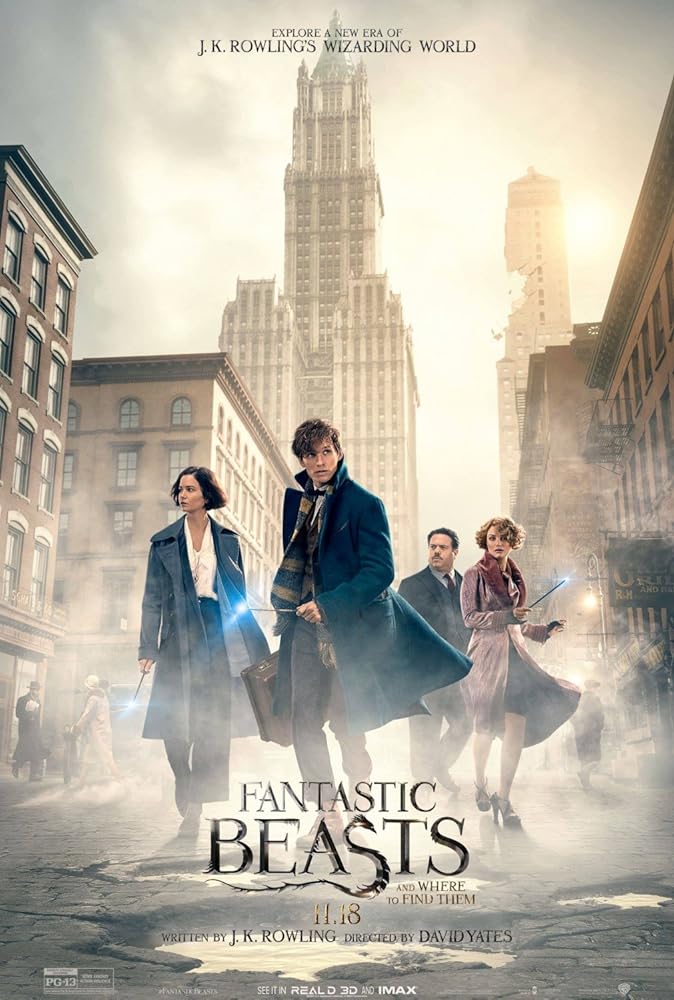
Fantastic Beasts and Where to Find Them (2016) review


The Harry Potter series is a franchise that needs no introduction at this point. The brainchild of author J.K. Rowling, this is very much one of the best ‘success stories’ in recent memory. After a few years spent struggling to get by as a single mom living in the U.K., Rowling published her first novel, Harry Potter and the Philosopher’s Stone (later retitled Sorcerer’s Stone for the U.S. release) in 1997, having come up with the idea for Harry Potter while on a delayed train ride to London. While it was initially rejected by 12 different publishers (who I’m sure are now fully regretting that decision), the book became a worldwide best-seller, as did its six follow-ups. With over 500 million copies sold to date, it is the best-selling book series of all-time. That success was then equally translated into film when Warner Bros. bought the film rights in 1999. The film adaptation of Sorcerer’s Stone was released in 2001 and the series would continue up until 2011 with 7 more films, including a two-part adaptation of the final book, Harry Potter and the Deathly Hallows. And like their book counterparts, the films were a massive critical and commercial success. It’s legitimately one of the rare franchises in which every entry in the series is great and the series ended up grossing over $7 billion worldwide, with the final entry, 2011’s Deathly Hallows Part 2, even going over $1 billion. And at that time, it seemed as if the series had come to an end. While Rowling has expanded the series since then through various forms of media, including a recent stage play titled Harry Potter and the Cursed Child that serves as the eighth installment of the series, it seems as if the story of Harry Potter, ‘the boy who lived’, has come to an end.

But this isn’t the end for the wizarding world, though. In 2013, it was announced that Rowling was writing a screenplay for a new film set within her wizarding world; Fantastic Beasts and Where to Find Them. This new project was particularly interesting given its ‘source material’. Instead of being based on a full novel like the Potter films were, this film is inspired by an in-universe textbook of the same name by author Newt Scamander that was one of the many textbooks that Harry Potter owned while at Hogwarts. Rowling even released the book for real in 2001. Obviously, the idea of a film that was inspired by a ‘textbook’ seems like a weird concept. But, we are talking about J.K. Rowling here, who makes her screenwriting debut with this ‘spin-off’ of the Harry Potter series that is set in 1920’s New York and follows the adventures of Newt Scamander. After spending a whole series overseas, we’re finally getting to see the American side of the Wizarding World. And not only does this film see the return of some of the franchise’s primary behind-the-scenes players, including producer David Heyman and writer Steve Kloves (who, for the record, is only a producer here), but also director David Yates, who helmed the final four Potter films. With that kind of pedigree, it seems like this should be another full-on success for this beloved franchise. And, ultimately, you would be right on that one, as Rowling and co. give us another highly entertaining adventure in the wizarding world that truly manages to stand on its own merit.  

In 1926, around 70 years prior to the events of the Harry Potter films, magizoologist Newt Scamander (Eddie Redmayne) arrives in New York City by boat. His primary possession is a suitcase containing various magical creatures that he has collected over the years. Things get rather complicated, however, when a run-in with No-Maj* (the American term for what the Potter books referred to as ‘Muggles’, AKA ‘non-wizarding folk’) Jacob Kowalski (Dan Fogler) ends up resulting in their suitcases getting switched and some of the creatures getting loose. And, unfortunately, this happens at a very bad time, as the American wizarding community, specifically the Magical Congress of the United States of America (MACUSA), is in the middle of dealing with the possible threat of exposure to the non-wizarding community. This is primarily due to a mysterious force that has been attacking the city and may or may not be connected to the dark wizard Grindelwald. And because MACUSA has instigated a ban on owning magical creatures, that puts Newt’s creatures in even more danger as they’re being blamed for the incidents. Thus, Newt and Jacob team up with MACUSA employee Tina Goldstein (Katherine Waterston) and her sister Queenie (Alison Sudol) to find his creatures before any harm can come to them.  

Despite a change in scenery, the world that this film creates is, for lack of a better term, just as magical as what we saw from the Potter films. Once again, you are fully immersed in the world that Rowling creates and the new setting of 1920’s New York provides plenty of creative scenarios that feel both new but also familiar (in a good way). And being a film called Fantastic Beasts and Where to Find Them, this film is very much full of ‘magical creature’-related sequences that are super fun to watch. But one of the coolest things about the film is that it is very much its own story. Sure, there are references to Harry Potter here and there (e.g. Dumbledore, Hogwarts, etc.) but they’re minor at best. And sure, these references might get more prevalent in future films. But for being the first installment of a new franchise, this film does succeed in standing on its own instead of having to rely on the arguably now nostalgic value of the Harry Potter films. Ultimately, though, the best thing that I can say about this film, as was the case with the eight Potter films, is that it does a fantastic job of balancing out the various traits of the story; the humor, the drama, the emotional depth, the charm, and the spectacle. That, my friends, is the sign of a great director and a great writer and this film has both in David Yates and J.K. Rowling, respectively. Yates’ direction is just as great as it was in the last four Potter films while Rowling’s writing, as usual, provides us with a terrifically-layered story that tackles strong themes like bigotry and prejudice amidst all the light-hearted magical adventures that the main characters find themselves in.

Speaking of which, one of the best things about this franchise in general has always been its ensemble cast. Every member of the Harry Potter cast was perfectly fit to play their respective roles. And the same can be said for the cast of Fantastic Beasts. The four main leads; Newt, Tina, Queenie, and Jacob, prove to be an excellent group of likable protagonists. They work well together and are well-matched in terms of their personalities, with Newt being the socially awkward main protagonist, Tina the kind but no-nonsense gal with a chip on her shoulder (as the result of an incident that led to her being removed from her position as an Auror (AKA basically a ‘wizard cop’)), Queenie the sweet flirt, and Jacob basically being the audience avatar of the situation; the No-Maj/Muggle (whatever one you prefer) who gets caught up in the wizarding world. In fact, this is basically the first time we’ve ever seen a non-wizard main character in this series. These four prove to be such an endearing group that, without giving anything major away, the way that the film closes out one of their story arcs is quite emotional. All in all, excellent performances from Eddie Redmayne, Katherine Waterston, Alison Sudol, and Dan Fogler. But like with any ‘Wizarding World’ film, this film also benefits from an excellent supporting cast playing an eclectic and interesting bunch of characters. There’s Colin Farrell as the rather sinister Auror Percival Graves, Ezra Miller as the mysterious young man Credence, Samantha Morton as Credence’s extremely bigoted No-Maj adopted mother Mary Lou who leads an extremist group looking to expose wizards, Carmen Ejogo as the stern president of MACUSA, the list goes on and on.

I’m not going to lie when I say that this was very much one of my most anticipated films of the year. Harry Potter is easily my favorite film franchise of all-time. Therefore, I was excited to see what would come out of a ‘Wizarding World’ film set in 1920’s New York with a screenplay written by J.K. Rowling herself. And I must say that the results are incredibly satisfying. Heck, I’m already imagining what they could do to implement this new side of the franchise into the ‘Wizarding World of Harry Potter’ lands at Universal Studios. Really, that’s the best part about the world that J.K. Rowling creates. It’s so imaginative that the possibilities are endless. But this is not just a prequel to Harry Potter. Aside from a few slight references here and there, this new film does stand on its own merit thanks to a great new cast of main characters and plenty of fun mayhem involving magical beasts. After all, this is called Fantastic Beasts and Where to Find Them. But through it all, thanks to the always great direction of David Yates and the always fantastic writing of J.K. Rowling, this film perfectly blends the charming spectacle of it all with a well-written story that contains strong themes, dark moments, and heartfelt emotional depth. In other words, exactly what the Harry Potter films had been doing for a decade. All in all, this film is an impressively self-contained story, so much so that it’s actually rather unclear as to where this series will go next, especially considering that there will apparently be four more films after this. But I assure you that this Potter fan is very much eager to see more of this new side of the Wizarding World.


Rating: 5/5!

Saturday, February 7, 2015

Jupiter Ascending (2015) review


The Wachowskis haven’t really been on that great a run this past decade in regards to the films that they’ve directed. Of course as we all know, the sibling directing duo first made headlines in 1999 when they made ‘The Matrix’, which is now regarded as one of the ground-breaking films of its time. But pretty much everything else after that has not fared as well either critically or commercially. First there were the two Matrix sequels, ‘Reloaded’ and ‘Revolutions’, which were both released in 2003. Both films fared pretty well commercially but for the most part they’ve been universally bashed by fans of the first film. All of their directorial efforts after that have been even less successful and have bombed at the box office. There was their 2008 adaptation of ‘Speed Racer’, which I’ll admit that I do remember liking when I first saw it. And then that was followed up by 2012’s ‘Cloud Atlas’, which was easily one of the most polarizing films of that year, and I for one was among those who weren’t that enthusiastic about it. Sadly it seems that this streak of box-office bombs is set to continue with their latest film, and first original directorial project since ‘The Matrix’, ‘Jupiter Ascending’. And unfortunately, the fact that the film itself is quite a mess in terms of its story doesn’t help it either.

The film takes place in a world where the planet Earth is actually under the control of a powerful alien dynasty known as the House of Abrasax who harvest the planet’s living creatures every few millenniums in order to produce a special serum that basically makes them immortal. When Abrasax’s matriarch dies, her three children; Balem (Eddie Redmayne), Kalique (Tuppence Middleton), and Titus (Douglas Booth) come into conflict over the ‘inheritance’ AKA Earth. However, they soon learn of another ‘heir’ to the throne who comes in the form of Jupiter Jones (Mila Kunis), a young, unsuspecting, and unlucky Earth woman who spends most of her time working as a caretaker along with her mother. She soon learns that she possesses the same genetic signature as the former matriarch of the House of Abrasax and is the true heir to the throne. When Balem puts a bounty on her head so that he can collect the inheritance for himself, a genetically-engineered ex-military hunter named Caine Wise (Channing Tatum), along with the help of his old military ally Stinger Apini (Sean Bean), comes to her rescue so that she can probably collect her inheritance before Balem ends up harvesting Planet Earth.

One thing that you can always expect from the Wachowskis is that their films will be full of eye-popping visuals and that is definitely the case here. This film was pushed back a few months so that they could have more time to work on the visuals and in that regard, that extra time did pay off. True the visuals can sometimes be a major eyesore at times due to the occasional visual overload but they’re still quite visually appealing. The world-building of this original story is pretty impressive and the action sequences are also pretty solid, especially a key chase sequence in the beginning in Chicago. However, the story is where the film really starts to come apart. The best way I can describe it is that it feels just a bit too overly complicated at times when in reality it’s sort of a fairly simple story. There are quite a lot of twists and turns but not in a good way. In fact, if you’re going into this expecting an action packed sci-fi film, then prepare to be very disappointed because there actually really isn’t that much action in this; it’s more dialogue-based and that does get rather boring after a while. Not only is the story dull, but a lot of the characters aren’t that interesting either. Heck, some don’t even get much development at all, like the two other Abrasax heirs who disappear from the movie entirely by the end of the film and the alleged ‘motivation’ that I read about online about how Stinger was looking for a cure for his daughter’s illness, which for the record is never explored once in this.

Jupiter herself is also a conundrum of a character. While she does serve her purpose of being the ‘avatar’ for the audience in this strange sci-fi world, she doesn’t have that much of an arc in this and we really don’t see her grow that much; for the most part she’s just a damsel in distress. While the character is a fairly weak female lead, Mila Kunis, to her credit, does a good enough job with the limited material that she has to work with. Channing Tatum and Sean Bean, on the other hand, do have a little more to work with, though still not that much, and they do have some pretty solid camaraderie with one another. But as for Eddie Redmayne as the main villain Balem, the poor guy’s lucky that he has that Oscar nomination for ‘Theory of Everything’ because let me tell you, this performance is more than likely going to be amongst next year’s Razzie nominations. Most of the time he whispers his dialogue sounding like Lord Voldemort from ‘Harry Potter’ in need of a throat lozenge and other times he suddenly shouts at the top of his lungs a la Michael Shannon or Gary Oldman. It’s an incredibly awkward performance but thankfully he’s not in the movie too much. Seriously, he disappears for at least about 30-40 minutes in the middle of the film before resurfacing for the finale. Though in the end, I think this is more a case of bad direction than it is the fault of Redmayne.

For the record, I didn’t ‘hate’ ‘Jupiter Ascending’ as there are good things in it, like the visuals, the action sequences, and some of the performances. But for the most part, it’s just a mess and that’s mainly because of the story being more complicated than it really needed to be. Not only that, but some plotlines are never fully resolved and the film is actually rather boring at times due to the fact that a lot of the film mostly consists of scenes of dialogue instead of action sequences, which is even more disappointing given the fact that this was being referred to as a mix between ‘Star Wars’ and ‘The Matrix’. That and, well, there’s also one of the biggest acting misfires in recent history in regards to Eddie Redmayne’s turn as the main villain Balem. Hopefully this won’t be a case of the supposed ‘Norbit’ curse that ‘supposedly’ plagues any Oscar-nominated actor who has a critically maligned movie come out in the weeks before the Oscars. In the end, it’s pretty much certain that ‘Jupiter Ascending’ is going to be a box-office bomb which is sad because A.) It’s clear the Wachowskis are really passionate about their work and B.) It just sucks in general whenever a film bombs. But unlike a film like ‘Jack the Giant Slayer’, ‘Jersey Boys’, or ‘Warrior’, there’s not much about this 2015 equivalent of ‘Attack of the Clones’ that I can defend.


Rating: 2/5

Saturday, November 29, 2014

The Theory of Everything (2014) review


Out of all of the famous scientists that have ever lived, from Albert Einstein to Kip Thorne (who just had a movie based around his scientific observations come out in Christopher Nolan’s ‘Interstellar’) Stephen Hawking is no doubt one of the first that comes to mind. After all, he was one of the two leading minds, along with Roger Penrose, on ‘gravitational singularity theorems’, predicted the concept of black hole radiation, and perhaps most importantly explored the union of the ‘theory of relativity’ and ‘quantum mechanics’. But at the same time, Hawking’s own life is quite fascinating given the fact that in his 20’s he was diagnosed with a motor neuron disease connected to amyotrophic lateral sclerosis (ALS, more commonly known as Lou Gehrig’s Disease as well as being the main cause for awareness behind all of those Ice Bucket Challenges you no doubt saw a lot of this past summer) and that story is the focus of ‘The Theory of Everything’. More specifically, this film is based on the book ‘Traveling to Infinity: My Life with Stephen’ by his first wife Jane Wilde as the film not only focuses on his life, but their relationship and how she stood by him as this disease slowly took over his life. And with some terrific and truly Oscar-worthy performances from leads Eddie Redmayne and Felicity Jones, ‘The Theory of Everything’ is a well-directed and moving biopic on the lives of both one of the most famous men in the entire world and the woman who was always there for him in times of crisis.

The film begins in 1962 as Stephen Hawking (Eddie Redmayne) begins his tenure as a graduate student at Cambridge studying cosmology where he quickly makes quite the impression with his teachers, specifically physicist Dennis Sciama (David Thewlis). While at a college party, he meets Jane Wilde (Felicity Jones), an arts major, and soon after they fall in love. But both of their lives take a serious detour one day after Stephen, who begins to show signs of clumsiness, ends up taking a nasty fall at school. At the hospital, he learns that he has a motor neuron disease similar to ALS which affect his muscles, resulting in them slowly degrading away. Because there is nothing that the doctors can do about it, it is projected that he only has two years to live. However, Jane promises to help him get through it driven by their love for each other and they end up getting married. With her love and support, Stephen fights to overcome his disability as he also continues to make quite the impression amongst his fellow physicists in the field of cosmology even as the disease slowly but surely eats away at him to the point where, after a near-death experience with pneumonia, he ends up losing his voice due to a tracheotomy resulting in him having to use a computerized voice to speak.

So I’ll admit that while I am familiar with Stephen Hawking, I admittedly didn’t know that much about him (nor do I know anything about any of the science in most of his work but don’t worry that science isn’t the main focus of this film) before seeing this. Having now seen this film, I can say that his story was a truly intriguing tale. I mean, this was a man who was given only two years to live and yet he managed to fight on even though it ended up resulting in him losing many things, namely the abilities to walk and talk. But of course, there’s more to this story. It’s also a tale of romance from the perspective of both Stephen and his wife Jane and we really see her spirit and determination supporting Stephen through the toughest moments of his life. But even then she does have her limits as I’m sure many will probably have in situations like this. The film does a great job at balancing their roles in the overall story meaning that while this is technically about Stephen Hawking’s life, Jane is as big a part of the story as he is. From an emotional standpoint, you do find yourselves very much invested in their relationship and sympathize with them when they both hit their own low points. All in all, this is a very well-polished film. The direction from James Marsh is solid as is the cinematography by Benoit Delhomme and the score by Johann Johannsson, resulting in a very nice-looking film backed up by a nice musical score.

But the key to this film is the performances from its two leads and I can safely say that after seeing this film that Eddie Redmayne and Felicity Jones are no doubt going to be front-runners for Best Actor and Best Actress at this year’s Oscars. Redmayne disappears into the role of Hawking perfectly and handles the transformation that Hawking went through incredibly well. Equally excellent here is Jones as Jane who does a phenomenal job at conveying both Jane’s strength and emotions in the key moments of the film. And as I noted earlier, because the film makes sure to balance out these two roles in the story, there’s never a time where one of them tries to outshine the other; they work off each other and are both superb. Of course, chemistry is key to making a film romance work and that is very much the case here. The two have excellent chemistry which really makes the relationship between Stephen and Jane feel very much genuine. The film does have a solid supporting cast as well, including Charlie Cox (AKA the new Daredevil for you Marvel fans) as Jonathan Jones, a musician who befriends Stephen and Jane, the latter of whom ended up marrying him after divorcing Stephen in 1995 (and no I don’t really consider that a spoiler given that this is a true story), and David Thewlis as Stephen’s physics professor at Cambridge but at the end of the day this film belongs to Redmayne and Jones.

‘The Theory of Everything’ is definitely one of the best films of this year as it offers a sometimes sad but also extremely uplifting look at how Stephen Hawking managed to overcome the disease that was predicted to take his life in just two years with the love of support of his wife Jane. It’s a well-crafted film that benefits greatly from its direction, writing, cinematography, and its score. And even if you don’t really understand a lot of the science that is talked about in this film… don’t worry you’re not alone and even then, that’s not actually the main focus of the film. Instead it’s about the relationship between Stephen and Jane. And at the end of the day, the best elements of this film are the Oscar-worthy performances from Eddie Redmayne and Felicity Jones in the lead roles of Stephen and Jane, respectively. Their chemistry is superb and both do a fantastic job at portraying these two and the struggles that they both overcame in dealing with Stephen’s ALS. It’s been said that this year’s Oscars are going to be pretty packed in regards to the acting categories but I do hope that both Redmayne and Jones earn Oscar nominations for their work here. In fact, I’d say it would be a genuine travesty if they didn’t get nominated because these are easily two of the best performances I’ve seen this year.


Rating: 4.5/5